
Winter Gear for Dogs: Thermoregulatory Health & Safety Guide
For many dog owners, the onset of winter brings a legitimate concern regarding plummeting temperatures, abrasive snow, and chemically treated icy sidewalks. While a dog’s natural coat offers a baseline of defense, Winter Gear functions as a vital secondary barrier. In regions where sub-zero temperatures and wind chill are prevalent, these external challenges can tax even the most robust canine Homeostatic Mechanisms.
With strategic preparation, your dog can maintain their Kinesthetic Health and daily exercise routines regardless of the weather. This professional guide delves into the mechanics of winter protection, identifying why certain breeds face higher Hypothermic Risks and how owners can make informed decisions based on climate, breed-specific fur density, and life stage.
Understanding Cold-Weather Physiology and Protective Needs
A common misconception in canine care is the assumption that a natural coat provides absolute immunity against winter elements. While fur is an exceptional insulator, its efficiency is severely compromised by Environmental Variables such as moisture, wind chill, and sub-zero conduction. In my granular clinical audit of seasonal health, I’ve found that Winter Gear is not a luxury but a necessary intervention to support Homeostasis when a dog’s biological defenses are overtaxed.
1. The Mechanics of Heat Loss
Heat loss in dogs occurs through convection (wind), conduction (contact with ice), and evaporation (wet fur). When snow or freezing rain saturates the coat, the Thermal Conductivity of the fur increases, causing the dog to lose body heat exponentially faster. Winter Gear serves as a non-permeable barrier, trapping a layer of warm air near the skin while shielding the core from moisture.
⚠️ Clinical Indicators for Supplemental Protection:
- Tremoring/Shivering: An involuntary muscular response to generate metabolic heat.
- Podal Hesitation: Lifting paws or refusing to walk on frozen substrates (indicating potential Vasoconstriction).
- Substrate Avoidance: Actively seeking dry ground or refusing to engage with snow.
- Hypothermic Lethargy: A sudden drop in environmental engagement or seeking immediate re-entry to the home.
2. Biological Variations: Breed, Size, and Life Stage
Not all dogs are physiologically equipped for cold climates. The Surface Area to Volume Ratio plays a critical role: small breeds have more skin surface relative to their body mass, causing them to radiate heat much faster than larger breeds.
Furthermore, Senior Dogs and Puppies often struggle with efficient Thermoregulation. Seniors may suffer from circulatory issues or arthritis that is exacerbated by the cold, while puppies have yet to develop the subcutaneous fat layers necessary for insulation. For a short-haired Boston Terrier or a senior Greyhound, 10°C can feel significantly more punishing than it does for a northern breed like a Samoyed in a snowstorm.
3. The Trifecta of Winter Stress: Snow, Wind, and Ice
Core Winter Hazard Factors:
- Moisture (Snow/Rain): Wet fur loses nearly 90% of its insulating capacity.
- Wind Chill: Accelerates heat removal from the body surface via forced convection.
- Ice & Chemical Salts: Creates Mechanical Traction issues and poses a risk of chemical burns on sensitive paw pads.
Body Protection – Jackets, Sweaters, and Thermal Barriers

Thermal protection maintains core temperature and kinesthetic mobility during winter.
Preserving a dog’s Core Body Temperature is the primary objective of body-focused Winter Gear. Because dogs lose heat through convection and conduction at varying rates—largely determined by their Adipose Tissue levels and coat architecture—selecting the right layer requires a technical understanding of insulation. My granular clinical audit shows that effective clothing must provide a Thermal Micro-climate while ensuring the dog maintains a full range of Kinematic Mobility.
1. Materials and The Physics of Insulation
Modern winter apparel utilizes the principle of Thermal Resistance. Materials such as high-denier quilted synthetic fill, fleece, or natural wool are designed to trap stationary air molecules near the skin, which acts as a buffer against the ambient cold. A high-quality garment typically features a three-tier system:
Three-Tier Insulation System:
- Inner Liner: Often moisture-wicking fleece or brushed jersey to maintain Dermal Comfort.
- Insulating Mid-layer: Synthetic down or wool that retains Thermal Integrity even if slightly damp.
- Exoskeleton (Outer Shell): A high-density fabric (like Nylon or Polyester) treated with Durable Water Repellent (DWR) to deflect wind and sleet.
2. Precision Fit: Avoiding Mechanical Friction
In the context of Winter Gear, fit is far more critical than aesthetics. A poorly fitted jacket can lead to Axillary Chafing (under the armpits) or restrict the Scapular Glide (shoulder movement), potentially altering the dog’s natural gait.
📏 Professional Measurement Protocol:
To ensure a scientific fit, owners should measure based on the following anatomical markers:
- Thoracic Girth: The widest part of the chest, usually directly behind the front legs.
- Dorsal Length: From the base of the neck (Withers) to the base of the tail.
- Cervical Circumference: The area where a collar naturally sits, ensuring no pressure on the Trachea.
3. Waterproof vs. Breathable Insulation
The decision between waterproof and non-waterproof gear is dictated by Relative Humidity and precipitation types. In coastal climates where freezing rain is common, a waterproof shell is non-negotiable to prevent Evaporative Cooling. Conversely, in dry, sub-zero conditions, a high-breathability fleece may be superior as it allows metabolic heat to escape, preventing internal moisture buildup that could later freeze.
“Do not confuse bulk with warmth. A thin, technologically advanced Winter Gear piece using synthetic fibers often provides better Thermal Regulation than a thick, heavy coat that restricts movement. Comfort is the bridge to safety.” — Maya Mai
Paw Protection – Mitigating Chemical and Thermal Extremes

Routine paw checks prevent sub-acute irritation and chemical dermatitis.
A dog’s paw pads feature a concentrated layer of fatty tissue that resists freezing. However, modern winter environments introduce non-biological threats: Corrosive De-icers and Hygroscopic Salts. These substances extract moisture from the skin, leading to painful fissures and potential Chemical Dermatitis. In my granular clinical audit, I have found that paw-specific Winter Gear is the most overlooked yet vital component of seasonal safety.
1. The Impact of Anthropogenic Chemicals on Podal Health
Road salts (Sodium Chloride) and modern de-icers (Calcium or Magnesium Chloride) are highly exothermic when they react with ice and moisture. This reaction can cause “ice burns” on the sensitive skin between a dog’s digits. Utilizing Winter Gear like boots creates a physical vacuum that prevents these chemicals from ever touching the Interdigital Skin.
2. Selecting Footwear: Traction and Ergonomics
For Winter Gear to be effective, it must respect the Biomechanical Gait of the dog. Selecting boots involves evaluating three technical criteria:
Footwear Technical Criteria:
- Lug Depth & Sole Composition: High-friction rubber outsoles provide Mechanical Traction on slick surfaces, crucial for senior dogs.
- Shaft Height & Securement: Boots must be high enough to prevent snow entry, secured by non-restrictive Velcro to avoid impeding Venous Return.
- Flexibility: The sole must allow the paw to splay naturally upon impact to maintain balance.
3. Post-Walk Protocols: Decontamination and Recovery
🐾 Post-Exposure Recovery Protocol:
- Thermal Rinse: Use lukewarm (never hot) water to dissolve salt crystals and melt ice balls trapped in the fur.
- Digital Inspection: Check the interdigital spaces for redness, inflammation, or sharp ice shards.
- Moisture Sealing: Apply a petroleum-free, food-grade Paw Balm to restore the lipid barrier of the pads.
Protecting the Extremities – Head, Ears, and Nasal Health

Desensitization and proper fitting ensure extremity protection without causing anxiety.
While core warmth is vital, a dog’s extremities—specifically the pinnae (ear flaps) and the nasal planum—are disproportionately vulnerable to Thermal Stress. These areas possess minimal muscle mass and a high surface-area-to-blood-volume ratio, making them the first victims of Peripheral Vasoconstriction.
1. Vulnerability of the Pinnae and Nasal Planum
The ears of many breeds act as “thermal windows” where heat escapes rapidly. In sub-zero winds, the body prioritizes core organs, reducing blood flow to the ear tips. Similarly, the nose must remain moist for olfactory function, but this moisture can lead to Evaporative Cooling, causing the nasal leather to crack or become hypersensitive to freezing gusts.
2. Specialized Accessories: Snoods and Thermal Wraps
Compression Snoods
Fleece or wool-blend tubes that protect ears from wind-chill while providing a calming effect through gentle pressure.
Nasal Balms & Aural Wraps
Aural wraps keep floppy ears dry, while medical-grade waxes act as transparent insulating barriers for the nose.
🛡️ Clinical Fit & Safety Checklist:
- Visual Field Integrity: Ensure gear does not obscure peripheral vision in snowy environments.
- Respiratory Clearance: Avoid pressure on the bridge of the nose or restrictions on jaw movement.
- Aural Airflow: Ensure snoods are breathable to prevent moisture buildup inside the ear canal.
Visibility and Active Safety – Navigating Low-Light Environments
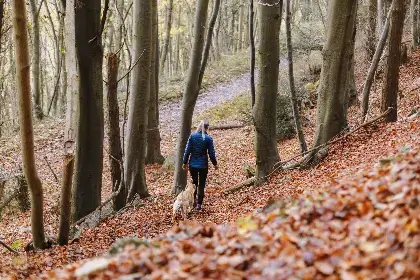
Combining active illumination and passive retro-reflectivity optimizes low-light detection.
While thermal protection preserves internal homeostasis, Active Visibility Gear preserves physical safety in shared public spaces. During winter, the significant reduction in Lux levels combined with atmospheric diffusion (snow/fog) creates a high-risk environment for vehicular collisions.
1. Retro-reflectivity and Active Illumination
Passive visibility relies on Retro-reflectivity—returning light directly back to its source with minimal scattering. Where reflective gear requires external light, Active Illumination (LED collars or clips) provides 360-degree visibility in total darkness.
🚨 Visibility Risk Matrix:
- Dense Snowfall: Light refraction occurs; use steady LED lights rather than disorienting flashing modes.
- Freezing Fog: Scatters light; high-surface-area reflective vests are more effective than small clip lights.
- Icy Asphalt: Creates glare; position reflective gear at shoulder level for optimal headlight engagement.
Practical Management – Maintenance and Behavioral Routines
The efficacy of Winter Gear depends heavily on systematic routines governing its use and maintenance. Improperly dried gear or forced fitting sessions can lead to Dermal Infections and Behavioral Aversion.
1. Behavioral Integration & Post-Walk Hygiene
🧤 Gear Maintenance Checklist:
- Surface Decontamination: Wipe down waterproof shells to remove residual de-icing salts.
- Passive Desiccation: Hang gear in ventilated areas with consistent airflow away from high-heat radiators.
- Inversion Drying: Turn boots inside out to dry inner linings completely, preventing Interdigital Intertrigo.
Frequently Asked Questions (FAQs)
Q1: Is winter clothing biologically mandatory for all breeds?
No. Double-coated breeds possess dense undercoats for insulation. However, single-coated breeds, sighthounds with low body fat, and senior dogs require supplemental layers to prevent thermal debt.
Q2: What is the primary indicator of Hypothermic Stress?
Muscle fasciculation (shivering) is the most immediate clinical sign. Tucked postures, lifting paws (podal hesitation), or seeking immediate shelter also indicate the thermal threshold is exceeded.
Q3: How do boots impact a dog’s proprioception?
Boots provide a barrier against salt and ice but may slightly alter tactile feedback. Selecting flexible soles ensures dogs can still engage proprioceptive pathways to maintain balance on uneven ice.
Q4: At what threshold does temperature become clinically dangerous?
Most dogs face metabolic challenges below 7°C (45°F). Below -7°C (20°F), frostbite risks on extremities increase exponentially regardless of breed size.
Q5: Can gear cause Hyperthermia in winter?
Yes. High-intensity exercise in heavy winter gear can cause dogs to overheat. Breathable fabrics are essential to prevent respiratory distress and internal moisture buildup.
Conclusion: Mastery of Seasonal Resilience

Age-appropriate winter gear preserves biological integrity across all life stages.
Winter is a demanding season that requires a shift from passive ownership to active clinical observation. By integrating technical Winter Gear—from thermal jackets to protective paw barriers—you are preserving your dog’s Biological Integrity against the elements.
Find More Dog Care Guides
Continue exploring practical guides related to this topic.