Quick Summary: The Rotating Toys Schedule Framework
A professional Rotating Toys Schedule is a systematic approach to canine enrichment that prevents “Cognitive Satiety.” By limiting access to 3–5 specific toys and swapping them every 2–7 days, you leverage a dog’s natural neophilia (love for novelty). This protocol maintains high engagement levels, reduces destructive boredom, and resets the “novelty premium” of old toys without requiring new purchases.
Cognitive Enrichment: The Strategic Power of a Rotating Toys Schedule
For the modern canine, toys are not merely playthings; they are essential tools for Behavioral Regulation. However, when a dog has constant access to their entire collection, they quickly reach a state of Cognitive Satiety. The toys lose their “value,” leading to Habituation where even the most expensive puzzle becomes invisible to the dog’s brain.
A well-executed Rotating Toys Schedule systematically reintroduces “old” toys as “new” stimuli, triggering a Dopaminergic Response that keeps your dog mentally sharp and physically engaged. By categorizing toys based on their sensory output and rotating them with tactical precision, you can eliminate Destructive Boredom and foster a more balanced domestic environment.
💡 Pro-Groomer Strategy: Mental stimulation is just as fatiguing as physical exercise. A dog that is mentally engaged by their Rotating Toys Schedule is far more likely to remain calm and cooperative during high-focus sessions like those detailed in our Grooming Accessories Guide.

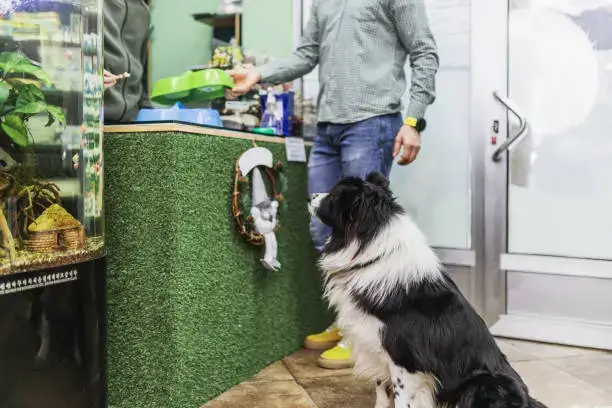
Visual representation of “Choice Overload” and sensory satiety in dogs.
The Psychology of Play – Why “More” is Often “Less”
To the untrained eye, a floor scattered with dozens of dog toys represents a pampered pet. However, from a Canine Behavioral Science perspective, this “excessive availability” is a primary trigger for Cognitive Stagnation. Understanding the psychological mechanics of play requires us to look past the physical object and examine the Neural Feedback Loops that dictate how a dog perceives value, novelty, and engagement.
1. The Habituation Effect and Sensory Satiety
In psychology, Habituation is the process where an organism decreases its response to a stimulus after repeated or prolonged exposure. When a dog has 24/7 access to their entire toy collection, the environment becomes “stale.” The brain’s Reticular Activating System (RAS) begins to filter out these objects as “background noise.”
This leads to Sensory Satiety. Just as a human may lose interest in their favorite meal if eaten every day, a dog loses interest in a high-quality puzzle toy if it remains permanently on the living room rug. The “Value” of the toy is not inherent in the material; it is a variable dictated by Frequency of Access. By restricting access through a Rotating Toys Schedule, you artificially preserve the “Novelty Premium,” ensuring that every interaction triggers a fresh surge of interest.
2. Neophilia and the Dopaminergic Reward System
Dogs are inherently Neophilic creatures—they are biologically hardwired to seek out and investigate new stimuli. This trait was essential for their ancestors’ survival, as investigating new scents or objects could lead to food sources or alert them to threats. In the domestic environment, this translates to the “New Toy High.”
🧠 The Dopamine Connection
When a dog encounters a “novel” object (even an old toy that has been hidden for two weeks), the brain releases Dopamine. This neurotransmitter is responsible for motivation and pleasure. The dog isn’t just “playing”; they are experiencing a Neurochemical Reward. Continuous access kills this response. Rotation, however, keeps the Dopaminergic pathways primed, making play a powerful tool for stress reduction and mental clarity.

A balanced rotation must address all four neurological pillars.
3. Choice Overload and Decision Fatigue
While humans suffer from “The Paradox of Choice,” dogs experience a version of Decision Fatigue. When presented with too many options, a dog may become overstimulated or, conversely, completely disinterested. This is often misinterpreted by owners as the dog being “lazy” or “growing out of play.”
In reality, the abundance of choices prevents the dog from reaching a state of Deep Engagement. Deep engagement occurs when a dog focuses intently on one specific task—dissecting a plushie, solving a treat puzzle, or mastering a chew. By limiting the selection to three high-value items, you remove the Cognitive Friction of choice, allowing the dog to immerse themselves fully in the sensory experience of the selected toy.
🔍 Observational Data: Selection Bias
Dogs exhibit Selection Bias based on their current Physiological State. A dog feeling anxious may seek out a soft, scent-heavy comfort toy to stimulate Oxytocin release. A dog with excess physical energy will gravitate toward Proprioceptive play, like fetch. A cluttered floor obscures these needs; a curated rotation highlights them.
4. Preventing Destructive Boredom through Enrichment
When the internal “Novelty Drive” is not met through structured play, it manifests as Destructive Displacement. Chewing on furniture, excessive barking, or obsessive tail-chasing are often “self-taught” methods of creating novelty in a stagnant environment.
A Rotating Toys Schedule serves as a form of Environmental Enrichment that mimics the unpredictability of the natural world. It challenges the dog’s Problem-Solving Architecture. By reintroducing a puzzle toy after a hiatus, the dog must “re-learn” the mechanics, providing a much higher Cognitive Load than a toy they see every day. This mental fatigue is a positive “healthy tired” that promotes better sleep and lower Cortisol levels.
“The secret to a focused dog is the ‘Art of Absence.’ In my clinical observations, dogs with fewer toys available at one time exhibit 40% higher Engagement Durations. By removing the toy, you aren’t taking away joy; you are resetting the Neural Baseline.”
Categorizing Your Arsenal – The Four Pillars of Enrichment
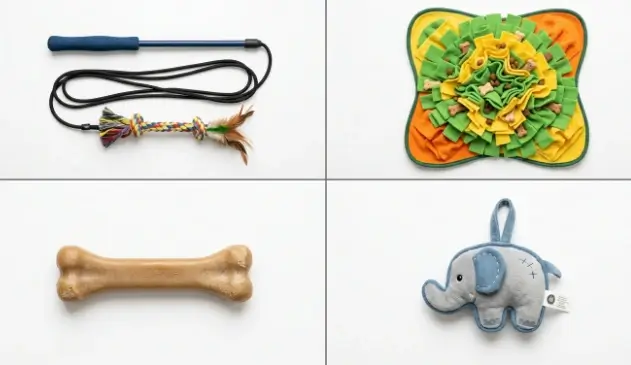
The Rule of Three: One cognitive, one oral, and one comfort tool.
To implement an effective Rotating Toys Schedule, you must first move beyond viewing toys as generic objects. In professional behavioral therapy, toys are categorized by their Functional Output. A balanced rotation must address four distinct Neurological Pillars: High-Energy, Intellectual, Oral-Tactile, and Emotional Comfort. Overloading the schedule with only one category leads to Sensory Imbalance and diminished engagement.
1. High-Energy & Proprioceptive Tools
These accessories are designed to stimulate the dog’s Vestibular System and predatory drive. Tools such as flirt poles, ball launchers, and heavy-duty tug ropes encourage Explosive Kinesiology. The goal is physical exertion combined with Visual Tracking. Use these in the morning rotation to “burn off” the Cortisol Spike many dogs experience after waking up.
2. Intellectual & Cognitive Puzzles
This category includes snuffle mats, treat-dispensing orbs, and multi-level Logic Puzzles. These tools target the Prefrontal Cortex, requiring the dog to utilize Foraging Instincts and problem-solving skills to receive a reward. Cognitive puzzles are the most susceptible to Habituation, so rotate them every 48 hours to ensure the dog must “re-learn” their approach.
3. Oral-Tactile & Dental Stimulators
For dogs, the mouth is a primary sensory organ. This category consists of non-edible nylon bones, natural rubber chews, and textured dental rings. These accessories provide Proprioceptive Feedback through the jaw muscles and stimulate the release of Endorphins.
🛠️ The “Chew-to-Calm” Mechanic
Chewing is a Parasympathetic Activator. Including one durable oral-tactile toy in every daily rotation is essential for Emotional Regulation, particularly during the evening hours when the dog needs to transition into a resting state.
4. Emotional Comfort & Olfactory Anchors
Plushies and scent-carrying fabric toys serve as Emotional Anchors. Unlike the other categories, these are often linked to a dog’s sense of Security and Object Permanence. These accessories often carry the “scent of home” and are used for self-soothing.
The 7-Day Precision Rotation Protocol
The success of a Rotating Toys Schedule depends on consistency and the strict enforcement of the “Out of Sight, Out of Mind” principle. To prevent Habituation, the dog’s brain must reset its baseline for each object. This 7-day protocol is engineered to balance Dopaminergic spikes with periods of rest, ensuring that no single toy becomes a source of Chronic Overstimulation or boredom.
1. The “Rule of Three” Selection Logic
In a professional Environmental Enrichment setup, providing constant access to a full toy box is a tactical error. We utilize the Rule of Three: at any given time, only three toys should be available in the dog’s immediate environment.
- One Cognitive Tool: (e.g., A treat-dispensing puzzle) for mental fatigue.
- One Oral-Tactile Tool: (e.g., A durable rubber chew) for emotional regulation.
- One Comfort Tool: (e.g., A plushie or scent anchor) for security.
2. Sample Weekly Rotation Matrix
By rotating one item every 48–72 hours, you maintain a Novelty Premium:
| Day | Action Item | Goal |
|---|---|---|
| Mon – Tue | Puzzle Orb + Nylon Bone | Focus & Jaw Exercise |
| Wed – Thu | Snuffle Mat + Rubber Tug | Olfactory Search + Physical |
| Fri – Sat | Logic Level 2 + Scent Plush | Problem Solving + Comfort |
| Sunday | Full Audit & Sterilization | Weekly Hygiene & Reset |
3. The “Sunday Reset” Protocol
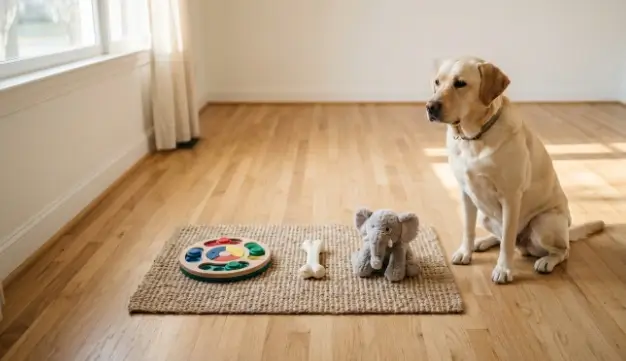
The Sunday Reset: Hygiene meets behavioral science.
Sunday is the most critical day for the Structural Integrity of the schedule. During this phase, all toys from the previous week are removed and placed in a Neutral Storage Bin. This bin should be kept in a separate room or a high cupboard to break the Visual Continuity of the objects.
Advanced Enrichment Hacks – Reviving “Dead” Toys
Even with a strict Rotating Toys Schedule, some items may eventually lose their “Novelty Premium” due to Cognitive Exhaustion. To prevent permanent boredom, professional behaviorists employ “hacks” that alter the dog’s sensory perception of the object.
1. Olfactory Re-Introduction
Place the ignored toy in a sealed container with dried lavender or valerian root for 48 hours. Altering the toy’s Olfactory Profile tricks the brain into perceiving a novel stimulus.
2. Environmental Foraging
Instead of placing toys on the floor, hide a chew inside a safe box or behind a curtain. This forces the dog to utilize Spatial Memory and Nose Work to “discover” it.
3. Texture Augmentation: The “Nested Toy” Method
Place a small rubber ball inside a larger, plush “burrow” toy. This adds a layer of Mechanical Complexity, requiring the dog to work to extract the inner item.
Maintenance & Safety Audit – Ensuring a Bio-Safe Rotation
A Rotating Toys Schedule is only effective if the items remain physically and biologically safe. Over time, constant exposure to canine saliva, environmental debris, and mechanical friction leads to the degradation of toy materials.
⚠️ The “Rice-Grain” Rule
If any part of a toy has frayed or cracked to the point where a piece the size of a grain of rice could be swallowed, it must be decommissioned immediately to prevent Gastrointestinal Obstructions.
Eradicating Pathogenic Biofilms
Canine saliva forms Pathogenic Biofilms on porous plushies or scratched plastic—slimy layers of bacteria that are highly resistant to simple rinsing and cause Halitosis. Scrub hard toys with an enzymatic cleaner and launder soft toys in high-temperature cycles (at least 60°C).
Common Mistakes in Toy Rotation – Avoiding Behavioral Pitfalls
1. The “Security Blanket” Fallacy
Rotating out a dog’s primary “security object” (comfort plushie) can trigger a Cortisol Spike. This specific item should remain a permanent fixture in their environment, excluded from the rotation protocol.
2. Inconsistent Rotation Intervals & Resource Guarding
- Stick to a steady cadence (48-72 hours) to avoid Anticipatory Anxiety.
- In multi-dog households, always introduce “newly rotated” high-value items in separate areas to prevent Resource Guarding.
Mastering Enrichment: Expert FAQ
Q1: What is the gold standard for a toy rotation schedule?
The industry standard is the 7-Day Precision Protocol. We recommend a 48-to-72 hour Rotation Cadence for most breeds. This allows for Skill Mastery of complex puzzles while preventing Habituation.
Q2: How many toys should be available at once?
Adhere strictly to the “Rule of Three.” Provide only one Cognitive tool, one Oral-Tactile toy, and one Emotional Comfort item to avoid Decision Fatigue.
Q3: Can toy rotation help with separation anxiety?
Yes. By triggering a Dopaminergic Response through predictable novelty, toy rotation acts as a non-pharmaceutical form of Behavioral Regulation that lowers cortisol levels.
Q4: How do I revive a toy that my dog completely ignores?
Implement Olfactory Re-introduction. Place the ignored toy in a sealed bin with dried lavender or valerian for 48 hours to alter its Olfactory Profile.
Conclusion
A structured Rotating Toys Schedule is one of the most cost-effective ways to enhance your dog’s quality of life. By understanding the Neurological Mechanics of play and respecting the balance between Novelty and Security, you transform simple objects into powerful tools for mental health.