“Superior equipment does more than enhance a dog’s silhouette; it safeguards both the handler and the pet. Selecting the right Grooming Accessories is the foundation for transitioning a stressful hygiene session into a therapeutic bonding experience, ensuring maximum Grooming efficacy while preserving Dermatological integrity.”
Precision Gear: Mastering Your Selection of Grooming Accessories
Investing in professional-grade Grooming Accessories is a long-term investment in your dog’s physiological health. The global market is saturated with generic products, but true grooming mastery requires tools engineered for specific Coat Morphologies and epidermal sensitivities. From high-carbon stainless steel shears to Ergonomic slicker brushes, every accessory serves a definitive clinical purpose in your home hygiene routine. Developing an intuitive feel for your equipment allows for better Tactile feedback, enabling you to detect early signs of skin abnormalities while preventing Mechanical Damage to the hair shaft. This guide curates the essential and advanced gear necessary to achieve salon-level results with professional precision.
💡 Pro-Groomer Strategy: Even the most advanced accessories will fail if the coat is prepared incorrectly. Ensure you have mastered the foundational moisture management protocols detailed in our guide on Coat Drying Techniques before advancing to precision styling.
The Core Essentials – Must-Have Brushes & Combs
In the clinical practice of canine hygiene, the distinction between a “brush” and a “professional grooming instrument” lies in its ability to interact with the hair shaft without compromising the skin’s Lipid Barrier. The core essentials of your grooming kit are the primary defense against Compacted Undercoats and Environmental Dander. Understanding the mechanical purpose of each tool is vital for maintaining a healthy, vibrant coat.
1. The Ergonomic Slicker Brush: The Engine of De-matting
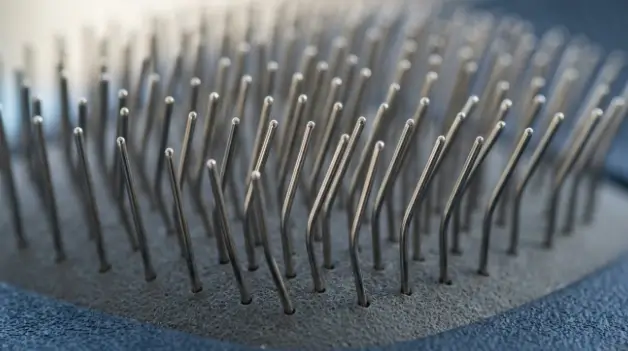
High pin density ensures efficient removal of dead undercoat without dermal irritation.
The Slicker Brush is arguably the most versatile yet misunderstood accessory in the groomer’s arsenal. Characterized by rows of fine, Angular Wire Pins set into a flexible rubber pad, its primary function is the removal of deep-seated loose fur and the prevention of Micro-mats.
High-quality slickers feature pins with specific Tensile Strength. If the pins are too rigid, they cause Abrasive Friction on the epidermis. If they are too soft, they fail to penetrate the secondary follicles of double-coated breeds. An ergonomic handle is not a luxury; it is a necessity to prevent Repetitive Strain Injury (RSI) for the handler during long sessions.
For breeds like Goldendoodles or Poodles, the slicker brush serves as a “fluffing” tool. When used during the drying phase, it facilitates Cuticle Realignment, resulting in the iconic “cloud-like” texture. Always look for stainless steel pins with polished tips to avoid micro-lacerations on sensitive skin.
2. The Stainless Steel “Greyhound” Comb: The Ultimate Auditor
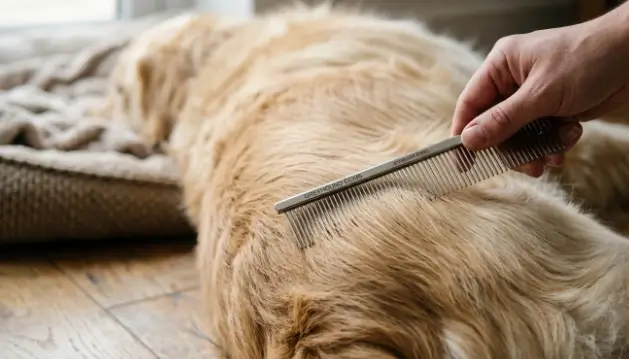
The Greyhound Comb: A critical tool for auditing the coat’s structural integrity.
While brushes provide surface aesthetics, the Stainless Steel Comb (often referred to as a Greyhound Comb) provides the “Truth.” In professional circles, a coat is not considered “groomed” until a fine-tooth steel comb can pass from the root to the tip without resistance.
🛠️ Precision Engineering Specifications:
- Dual-Spacing Design: Look for combs with a “Coarse” side for initial exploration and a “Fine” side for Detailed Follicular Alignment.
- Anti-Static Coating: Professional combs often feature a Teflon or chrome finish to facilitate Static Neutralization, preventing the fur from frizzing.
- Rounded Tines: The tips must be perfectly spherical to ensure they don’t scratch the Dermal Layer during deep combing.
This accessory is essential for “Line Combing”—a technique where the handler parts the fur to check for Pelted Undercoats. It is also the primary tool for managing high-friction areas like the “armpits,” hocks, and behind the ears, where mats form with the highest frequency.
3. The Rubber Curry Brush: Stimulating the Sebaceous Glands
For short-haired and smooth-coated breeds (like Boxers or Labradors), the rubber curry is the gold standard for Dermatological Health. Unlike metal-based tools, the curry brush utilizes Tackiness and Suction to lift dead hair while providing a therapeutic massage to the skin.
🌱 Biological Benefits:
The circular motion used with a rubber curry facilitates Blood Flow Vasodilation at the skin surface. This stimulates the Sebaceous Glands, encouraging the secretion of natural oils (Sebum) that provide the coat’s waterproof barrier and natural gloss. Furthermore, it is an excellent tool for Follicular Aeration, removing trapped dander that can lead to “doggy odor.”
4. Soft Bristle Brushes: The Finishing Polish
Often overlooked, the Bristle Brush is the final step in the “Core Essentials” hierarchy. Made from natural boar hair or high-grade synthetics, these brushes have a high surface-area contact. Their purpose is not to detangle, but to Distribute Sebum evenly across the entire hair shaft. This process seals the hair cuticle, protecting it from environmental pollutants and UV Oxidation.
“One of the most frequent ‘Vạch lá tìm sâu’ (needle in a haystack) mistakes I see is owners using only a slicker brush on long hair. While the surface looks fluffy, the undercoat remains compacted near the skin. My Expert Verdict: Never consider a dog fully brushed until you have used a steel comb to verify every inch of the coat. Without the comb, you are simply grooming the surface of a problem.”
Selecting these core accessories based on Mechanical Efficacy rather than price point ensures that your home grooming routine remains both safe and effective. By matching the tool’s Pin Geometry and material to your dog’s specific coat morphology, you transform a chore into a professional-grade health treatment.
Precision Clipping & Shearing Tools
When moving beyond surface maintenance into the realm of structural grooming, the quality of your cutting instruments becomes a matter of Dermatological Safety. Professional Grooming Accessories designed for clipping and shearing must maintain an exceptional edge to prevent Hair Shaft Crushing, which leads to split ends and uneven growth. Precision in this category is not just about aesthetics; it is about minimizing the time your dog spends under Mechanical Stress.
1. Safety Shears: The Importance of Rounded Tips
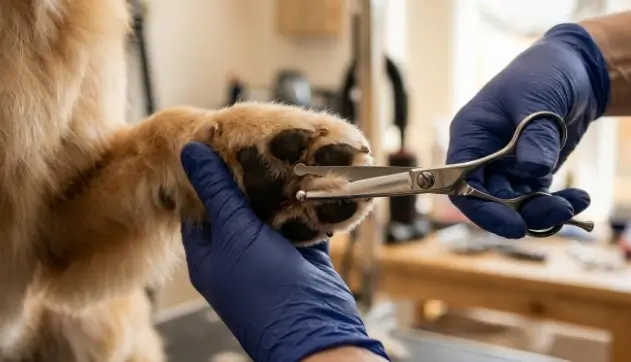
Ball-tip shears minimize the risk of accidental lacerations in sensitive interdigital spaces.
For home groomers, the primary risk during shearing is sudden movement. Safety Shears (Ball-tip scissors) are engineered with blunt, rounded ends to mitigate the risk of Lacerations in high-sensitivity zones such as the medial canthus (eye corners), the auricular margins (ear edges), and the interdigital spaces (between toes).
Avoid generic craft scissors. Professional grooming shears utilize High-Carbon Stainless Steel (such as 440C or Japanese VG10). This ensures the blades remain sharp for hundreds of sessions, providing a “clean crisp” cut that doesn’t pull on the Sensitive Nerve Endings located at the hair follicle’s base.
2. Nail Maintenance: Guillotine vs. Plier-Style Clippers
Nail care is often the most anxiety-inducing aspect of Grooming Accessories. The choice between a Guillotine Clipper and a Plier-Style Clipper should be based on the diameter and Bone Density of the dog’s claws.
- Plier-Style (Heavy Duty): Feature a tension spring and a safety guard. These are superior for large breeds with thick, opaque claws, providing the Leverage necessary to cut without crushing the Quick (the internal vascular structure).
- Guillotine Style: Utilize a single-blade action, ideal for small to medium breeds. They offer high visibility but require frequent blade replacements to maintain Shearing Efficacy.
3. The Electric Nail Grinder: Acoustic & Thermal Safety
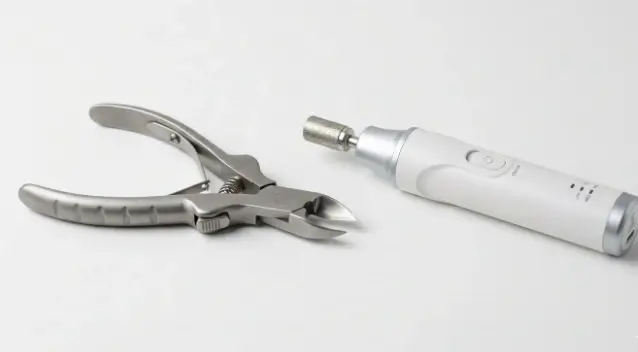
Electric grinders provide a smoother finish and reduce the risk of cutting the quick.
Modern Nail Grinders (Dremel tools) have revolutionized paw hygiene by replacing the “sharp snap” of a clipper with a controlled Abrasive Sanding process. This is particularly beneficial for dogs with Nail Phobia. High-quality grinders feature Brushless Motors to minimize noise and Diamond Bit Heads to prevent localized Heat Accumulation on the claw surface.
🛠️ Technical Tip: Quick Recession
Regular use of a grinder encourages the Vascular Quick to recede over time. This allow for shorter, healthier nails that don’t interfere with the dog’s Biomechanical Gait or cause skeletal misalignment due to improper paw placement.
“The silent killer of grooming confidence is a dull blade. Whether it’s a clipper or a pair of shears, if the metal doesn’t glide, it creates Tactile Discomfort for the dog. My Expert Verdict: Invest in tools with Ergonomic Offsets to protect your own wrist health while ensuring every cut is a clinical precision move, not a struggle.”
By selecting cutting accessories that prioritize Structural Integrity and safety features, you reduce the risk of accidental injury. High-quality steel and proper Mechanical Action ensure that these precision tools remain a functional part of your grooming kit for years to come.
The Bathing & Drying Kit – Essential Support Accessories
The bathing phase is often where Dermatological efficacy is either won or lost. Professional Grooming Accessories in this category are designed to facilitate deep-pore cleansing while mitigating the stress of water immersion. By utilizing tools that optimize Surfactant Distribution, you ensure that therapeutic shampoos reach the Epidermal Layer rather than just sitting on the surface of a water-repellent coat.
1. Silicone Scrubbing Mitts: Maximizing Mechanical Agitation
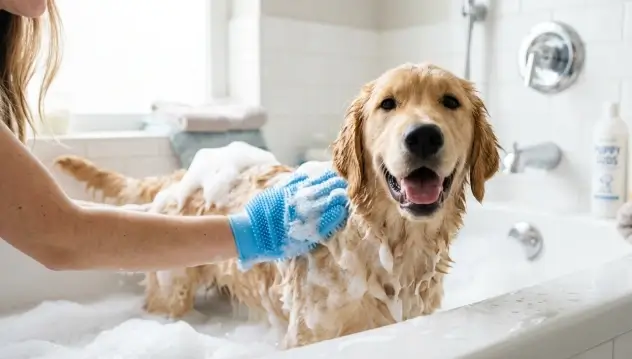
Traditional hand-washing often fails to penetrate the dense Undercoat of double-coated breeds. Silicone Scrubbing Mitts or “Zoom Grooms” utilize soft, flexible nodules to create Mechanical Agitation. This process breaks the surface tension of skin oils and trapped dander, allowing the shampoo’s Micelles to encapsulate and lift environmental pollutants more effectively.
Beyond cleaning, these accessories provide Lymphatic Drainage support. The gentle pressure stimulates subcutaneous circulation, promoting faster healing of minor skin irritations and encouraging the production of a healthy, vibrant Natural Sebum coating on the hair shaft.
2. High-Absorbency Microfibers & The “Pva” Shammy
Post-bath moisture management is the most critical factor in preventing Post-Grooming Chills. While we discussed techniques previously, the Accessory Selection is paramount. PVA (Polyvinyl Alcohol) Shammies act as “water magnets,” capable of holding vast quantities of liquid without becoming heavy or abrasive.
🛠️ Technical Specification: Capillary Wicking
High-grade microfiber accessories utilize a split-fiber weave that increases surface area by up to 40 times. This creates Capillary Wicking, which pulls moisture out of the Follicular Canal much faster than traditional cotton towels, drastically reducing the time required for high-velocity drying and minimizing Thermal Exposure.
3. Sensory Decompression: Happy Hoodies & Ear Protection
Modern grooming theory prioritizes Sensory Decompression. The high-decibel environment of a bath or dryer can trigger Acoustic Trauma and cortisol spikes. The Happy Hoodie—a fabric compression sleeve—dampens sound and provides gentle Deep Pressure Therapy, mimicking a “calming swaddle” that keeps the dog anchored and relaxed during the high-velocity drying phase.
“Many owners skip bathing accessories, thinking hands are enough. However, without a scrubbing mitt or a proper shammy, you often leave Residual Detergent trapped in the undercoat, leading to Chemical Dermatitis. My Expert Verdict: These accessories aren’t ‘extras’—they are the precision tools that ensure the bath is a clinical success rather than a skin irritant.”
Advanced & Specialty Accessories – The Professional Edge
For owners of double-coated, wire-haired, or senior dogs, standard brushes often fall short of clinical hygiene requirements. Advanced Grooming Accessories are designed to target specific anatomical challenges, such as Follicular Compaction and Vascular Accidents. Mastering these tools allows you to maintain the coat’s functional architecture while ensuring the safety of the dog during high-intensity grooming sessions.
1. Undercoat Rakes: Managing the “Coat Blow”
During seasonal shedding peaks, known as a “coat blow,” traditional slickers cannot reach the depth required to clear the Secondary Follicles. An Undercoat Rake features long, T-shaped pins designed to penetrate the harsh guard hairs and hook into the dead, woolly undercoat. This accessory is vital for preventing Dermal Suffocation, where trapped dead hair prevents airflow to the skin, leading to hotspots.
When selecting a rake, prioritize models with 360-degree Rotating Pins. These allow the tool to glide through tangles without pulling on the skin, significantly reducing Tactile Aversion in sensitive breeds like Siberian Huskies or Alaskan Malamutes.
2. Styptic Powder: The Critical First-Aid Accessory
In the context of YMYL (Your Money Your Life) safety, Styptic Powder is the most important specialty accessory in any kit. Accidents during nail trimming can happen to even the most experienced handlers. Styptic powder contains Ferric Subsulfate, an anti-hemorrhagic agent that causes immediate Vascular Constriction, sealing the “Quick” and preventing blood loss.
⚠️ Emergency Application:
Never perform a nail trim without an open container of styptic powder nearby. In the event of an over-cut, apply the powder with firm pressure using a moistened cotton swab for 30 seconds. This prevents Secondary Bacterial Infection of the exposed vascular canal.
3. Dematting Serrated Blades: Precision Extraction
When a mat becomes “pelted” (hardened against the skin), pulling with a comb is inhumane. Dematting Tools utilize razor-sharp, curved serrated blades that slice through the knot rather than pulling the follicle. These accessories must be used with extreme caution, utilizing a Picking Motion rather than a dragging motion to preserve the Primary Guard Hairs.
🛠️ Mechanical Tip: Blade Orientation
Professional dematting blades are designed to be “Skin-Safe,” meaning the outer edge is blunt while the inner curve is sharp. Always ensure the Dull Convex Side is facing the dog’s skin to prevent accidental nicks during the Detangling Phase.
“Advanced accessories are the ‘special forces’ of your grooming kit. While they are highly effective, they require a higher degree of Proprioceptive Awareness from the handler. My Expert Verdict: If you are using a dematting tool, always place your fingers between the blade and the dog’s skin. If you can’t feel the skin, you shouldn’t be cutting. Safety is the ultimate accessory.”
Accessory Maintenance & Sterilization – Protecting Your Investment
Even the highest quality Grooming Accessories will harbor pathogenic bacteria, fungi, and parasites if not maintained with clinical discipline. Over time, biological residue such as sebum and dander acts as a corrosive agent, leading to Oxidative Stress on metal surfaces and the degradation of ergonomic rubber grips. A strict sterilization protocol is essential to prevent Cross-contamination between pets and to ensure the longevity of your precision tools.
1. De-hairing and Mechanical Cleaning
The first stage of maintenance is the complete removal of Organic Matter. Hair trapped in the pins of a slicker brush or the pivot point of shears retains moisture, which triggers rust. Utilize a high-velocity air stream or a dedicated “cleaning comb” to clear the follicles from your brushes after every session. For shears and clippers, a soft-bristled brush should be used to clear Micro-shards of hair from the blade interface.
2. Clinical Sterilization: Barbicide & IPA Protocols
Wiping tools with a dry cloth is insufficient for Microbial Eradication. To maintain Dermatological Safety, metal accessories should be treated with a hospital-grade disinfectant or 70% Isopropyl Alcohol (IPA).
For combs and shears, utilize a 10-minute immersion in a disinfectant solution. This ensures the destruction of Staphylococcal bacteria and fungal spores like Ringworm (Dermatophytosis). After immersion, tools must be dried immediately with a lint-free cloth to prevent Pitting Corrosion.
3. Lubrication and Blade Alignment
Precision cutting tools require Hydrophobic Protection. High-carbon steel is susceptible to atmospheric moisture. Applying a single drop of Grooming Grade Mineral Oil to the pivot screw of your shears and the teeth of your clippers creates a barrier against oxygen. This reduces Kinetic Friction, ensuring the “Shear Action” remains smooth and silent, which in turn reduces the dog’s Sensory Stress.
🛠️ Storage Optimization:
Never store your Grooming Accessories in a damp bathroom environment. Utilize a ventilated tool roll or a hard-shell case with Silica Desiccant Packets. This maintains a low-humidity micro-climate that preserves the Structural Integrity of both the metal blades and the wooden or plastic handles.
“A dirty brush is a vehicle for infection. I have seen countless cases where a simple ‘itch’ turned into a full-blown Pyoderma because the owner used a brush contaminated with old sebum and bacteria. My Expert Verdict: If you wouldn’t use the tool on your own hair, don’t use it on your dog. Sterilization isn’t optional—it is a pillar of pet care.”
Common Selection Mistakes – Avoiding the “Generic Tool” Trap
Selecting Grooming Accessories based solely on price or visual appeal is a frequent error that leads to Follicular Trauma and owner frustration. High-quality tools are engineered with specific Tolerances to interact safely with canine physiology. Choosing the wrong equipment often results in “Brush Burn,” skin lacerations, or a permanently damaged coat texture.
1. The “Cheap Plastic” Fallacy
Low-cost accessories often utilize injection-molded plastics with Micro-burrs and sharp seams. These imperfections act like tiny saws on the hair shaft, causing Cuticle Fragmentation. Furthermore, cheap plastic pins lack the necessary Elasticity; they either snap under pressure or fail to retract, leading to excessive pulling on the Dermal Layer.
Cheap materials are highly porous, meaning they absorb bacteria and sebum that cannot be fully removed by standard sterilization. This creates a permanent reservoir for Pathogenic Biofilms, which are then redistributed across your dog’s skin during every grooming session.
2. Ignoring Tool-to-Breed Proportionality
A “one-size-fits-all” approach to Grooming Accessories is a major pitfall. Using a large slicker brush on a toy breed prevents the handler from reaching narrow anatomical junctions like the axillary regions (armpits). Conversely, using small tools on a giant breed increases the duration of Mechanical Friction, leading to skin irritation and Static Buildup.
3. Neglecting Accessory Lifespan
Even professional tools have a finite Operational Lifespan. Many owners continue to use shears that have lost their Axe-Edge Geometry or brushes with bent pins. A bent pin on a slicker brush does not just “miss hair”—it creates a hook that can snag and tear the Sensitive Epidermis.
🔍 The “Fingertip Test” for Replacement:
Run your fingertips lightly over the pins of your brushes and the edges of your combs. If you feel any sharp snags, irregular bending, or Pitting Corrosion, the tool has reached its Structural Failure Point and must be decommissioned immediately to prevent skin injury.
“Many owners think they are saving money by buying generic kits. However, in my ‘Vạch lá tìm sâu’ rà soát, I found that inferior metal in cheap shears actually causes ‘hair crushing,’ which leads to split ends and more tangles in the future. My Expert Verdict: Buy your Grooming Accessories once, and buy them right. Professional tools are an investment in your dog’s comfort and your own peace of mind.”
Frequently Asked Questions: Grooming Accessories Mastery
✂️ Can I use human hair scissors for my dog’s grooming?
It is strongly discouraged. Human hair is much thinner than canine fur. Professional Grooming Accessories like shears are engineered with specific Blade Tension and steel density to cut through coarse fur without folding the hair shaft or causing Mechanical Trauma to the follicle.
🔄 How often should I replace my grooming brushes?
A high-quality brush can last 2–3 years with proper maintenance. However, you must perform a Structural Integrity Check monthly. If you detect bent pins, missing protective tips, or Oxidative Corrosion, the tool should be replaced immediately to prevent microscopic skin lacerations.
🧼 What is the best way to sanitize metal accessories?
Utilize a 10-minute immersion in a 70% Isopropyl Alcohol solution or a dedicated hospital-grade disinfectant. This ensures Microbial Eradication of bacteria and fungal spores. Always dry tools instantly with a lint-free cloth to avoid Pitting Corrosion.
Maya’s Final Verdict: Gear with Purpose
The right Grooming Accessories are more than mere convenience; they are the physical extension of your care and expertise. By prioritizing Ergonomics, metallurgical quality, and clinical sterilization, you elevate your dog’s hygiene routine into a professional-grade health protocol. Remember, a tool is only as effective as the knowledge behind it.
Find More Dog Care Guides
Continue exploring practical guides related to this topic.