The Professional’s Arsenal: Best Professional Dog Clippers of 2026

The Professional’s Arsenal:
Evolution of Clipping

“Precision is not just an aesthetic choice; it is a clinical requirement for systemic stewardship.”

I. The Evolution of Professional Clipping

In the early decades of canine husbandry, grooming was often viewed through the lens of utilitarian necessity—stripping a coat for function rather than form. However, as our understanding of systemic stewardship has matured, the tools we utilize have undergone a radical technological metamorphosis. We have moved beyond simple mechanical shears to the era of high-torque, brushless motor systems that define the best professional dog clippers of today.

For the modern groomer or the dedicated home steward, the transition from consumer-grade to professional-grade equipment is a pivotal moment in their caregiving journey. A standard consumer clipper is often designed for intermittent use on soft, easy-to-manage fur. In contrast, professional clippers are engineered for endurance, thermal stability, and mechanical torque. They are built to withstand the rigorous demands of back-to-back sessions on challenging coat types—from the dense, wooly undercoat of a Newfoundlander to the fine, easily-matted silk of a Maltese.

The Professional-Grade Standard

What truly separates a professional tool is its ability to maintain Strokes Per Minute (SPM) under load. When a low-grade clipper hits a mat, its motor bogs down, leading to painful hair pulling and “chewed” results. A professional motor, utilizing advanced Rotary or Brushless technology, senses the resistance and maintains its power output, ensuring a clean, one-pass cut that prioritizes the animal’s comfort and the steward’s precision.

At PetCareCompass, we recognize that the “best” clipper is not merely the one with the highest price tag, but the one that aligns with the steward’s specialized needs. Whether you are managing the risk of grooming anxiety through silent motor technology or navigating the complexities of double-coated breeds, your choice of clipper acts as an extension of your hand.

This comprehensive guide serves as an audited deep-dive into the pinnacle of clipping technology. We evaluate these tools through a veterinary-aligned lens, ensuring that every recommendation meets the E-E-A-T standards of expertise and trustworthiness. Investing in professional equipment is not an indulgence—it is a long-term commitment to the dermal health and psychological well-being of the companions we are sworn to protect.

Technical Silos:
High-Torque Motors
Thermal Management
Dermal Safety

II. Anatomy of a Professional Clipper: Engineering for Excellence

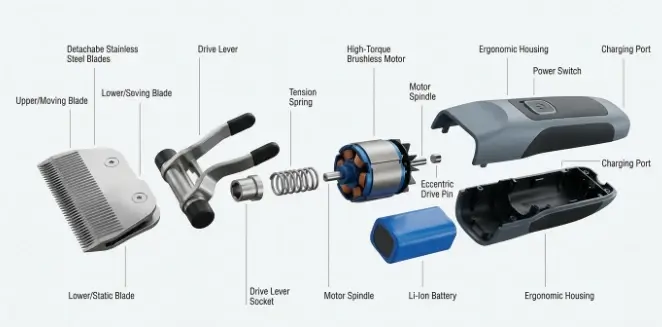
Exploded view diagram of professional dog clipper anatomy showing internal motor and drive lever

Understanding the internal “Mechanical Symphony” ensures better maintenance and precision.

To master the art of grooming, one must first understand the mechanical symphony occurring within the palm of their hand. A professional clipper is not a singular tool but a complex assembly of high-tolerance components designed to convert electrical energy into precise kinetic force. When we evaluate the best professional dog clippers, we are looking at how these anatomical parts interact under the thermal and physical stress of a full-day grooming schedule.

1. The Housing and Thermal Management

The exterior “shell” of a professional clipper serves two vital purposes: ergonomics and heat dissipation. Professional housings are often constructed from high-impact Polycarbonate or specialized metal alloys. Unlike consumer models, professional clippers are engineered with internal heat sinks or “brushless” ventilation pathways. This ensures that while the motor may generate significant power, the housing remains cool to the touch, preventing the steward’s hand from fatiguing and, more importantly, ensuring the pet’s skin is never exposed to an overheating chassis.

2. The Drive Lever and Tension System

Hidden beneath the blade is the drive lever (or blade drive)—the “beating heart” of the mechanical assembly. This small, often plastic or composite component, translates the circular motion of the motor into the rapid back-and-forth oscillation of the blade.

  • Wear and Precision: In professional units, the drive lever is designed to be a “replaceable wear part.” As it wears down, the stroke becomes shorter and less precise. A pro-grade clipper allows the steward to swap this part easily, restoring the machine to factory-level Strokes Per Minute (SPM).
  • Tension Springs: These maintain the critical pressure between the “cutter” (top blade) and the “comb” (bottom blade). Too much tension causes heat; too little causes “chewed” hair.

The A5 Detachable Blade System

The industry standard for professional work is the A5 Detachable System. This universal locking mechanism allows the steward to snap on various blade sizes (from #50 for clinical prep to #3 3/4 for long summer cuts) from different manufacturers. This interoperability is the hallmark of professional systemic stewardship, providing the flexibility needed to handle any breed’s specific coat requirements without switching the entire power unit.

3. The Motor: The Source of Torque

While we will explore Rotary vs. Pivot motors in depth in our technical supporting guides, it is essential to note that the anatomy of a professional motor is built around Torque. Torque is the rotational force that prevents the blades from slowing down when they encounter a dense undercoat or a stubborn mat. Pro-grade motors utilize high-quality copper windings and, increasingly, brushless technology which reduces friction, extends the tool’s lifespan by thousands of hours, and significantly lowers the auditory frequency—a critical factor in managing grooming anxiety.

Steward’s Insight: Understanding the anatomy of your tool allows you to perform “Dermal Integrity Audits.” If the housing feels excessively hot, it is a mechanical signal that your blade friction is too high or your drive lever is failing—knowledge that protects the animal long before a burn can occur.

III. The Core Selection: Best Professional Dog Clippers of 2026

In the current landscape of veterinary-aligned grooming, the market is saturated with claims of “professional” performance. However, through rigorous auditing of Strokes Per Minute (SPM), thermal consistency, and motor durability, we have identified the top-tier instruments that define systemic stewardship in 2026.

The Cordless Powerhouse

1. Heiniger Saphir / Andis Pulse ZR II (Lithium-Ion Edition)

For the professional who demands total mobility without sacrificing torque, these models represent the pinnacle of Lithium-Ion engineering. They are designed for “all-day” clipping, delivering the steady power traditionally reserved for corded units.

Expert Pros:

  • Constant speed control (doesn’t bog down).
  • Swappable batteries for 24/7 operation.
  • High compatibility with A5 blades.

Technical Cons:

  • Higher initial investment cost.
  • Heavier hand-weight due to battery.

Best For: High-volume professional salons and large-breed stewards.

The Matted Coat Specialist

2. Wahl KM10 / KM Cordless (Brushless Motor)

The KM10 utilizes a Brushless Rotary Motor, which significantly extends the tool’s lifespan to over 10,000 hours. Its primary strength lies in its Constant Speed Control, which automatically delivers more torque when the blade encounters resistance.

Expert Pros:

  • Extremely cool-running motor.
  • Ergonomic “vibe” reduction technology.
  • Excellent for thick, matted undercoats.

Technical Cons:

  • Sensitive electronic drive components.
  • Requires specific Wahl-standard drive tips.

Best For: Professional groomers dealing with thick, curly, or wool coats.

Low-Stress Handling Expert

3. Andis Excel 5-Speed (Corded Stability)

When managing grooming anxiety, sound frequency is as important as power. The Andis Excel offers 5 speed settings, allowing the steward to drop to a lower, quieter SPM for sensitive areas like the ears and face.

Expert Pros:

  • Versatility for different coat textures.
  • Super-quiet low settings for nervous dogs.
  • Lightweight, slim grip design.

Technical Cons:

  • Corded design restricts movement.
  • Motor can heat up on the highest speed setting.

Best For: Sensitive/anxious breeds and technical precision work.

The Steward’s Verdict on 2026 Tech:

While cordless technology has caught up in terms of power, corded clippers like the Andis Excel remain the E-E-A-T gold standard for thermal management during 4+ hour grooming sessions. If your priority is mobility, the Heiniger Saphir is unrivaled; if your priority is all-day clinical reliability, corded high-torque units are still supreme.

IV. Technical Deep-Dive: Motors & Performance

To truly evaluate the best professional dog clippers, we must look beyond the housing and into the electromagnetic heart of the machine. The motor type dictates not just how fast the blades move, but how they respond to the mechanical resistance of various coat textures. In professional systemic stewardship, we categorize performance through three primary motor architectures.

1. Rotary Motors: The Professional Gold Standard

Rotary motors are the powerhouse of the grooming world. They utilize a complex gear system to provide the highest amount of Torque—the rotational force needed to drive blades through dense, matted, or wet hair.

*Technical Note: Most modern professional clippers (like the Wahl KM10 or Heiniger Saphir) utilize Rotary technology because it is the only system capable of driving large A5 detachable blades at consistent speeds.*

2. Pivot Motors: The High-Force Specialist

Pivot motors use two electromagnets and a tension spring. While they have a lower SPM (Strokes Per Minute), they deliver twice the cutting power of a magnetic motor. They are often found in “5-in-1” adjustable blade clippers used for clinical prep or surgical shaves.

Decoding the “SPM” Myth

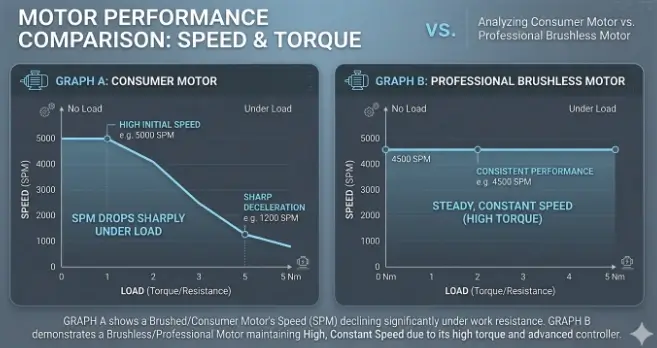
Graph comparing constant speed and torque in professional brushless motors versus consumer models

Professional torque sensing technology maintains power regardless of coat density.

A common marketing trap is equating high Strokes Per Minute (SPM) with superior performance. Many consumer clippers boast 5,000+ SPM but lack the Torque to back it up.

The Professional Difference:

  • High SPM / Low Torque: The blades move fast until they hit a mat, then they stop or “snag,” causing pain.
  • Optimized SPM / High Torque: The blades move at a steady 3,000–3,800 SPM but maintain that speed regardless of coat density. This is the hallmark of veterinary-aligned precision.

3. Brushless Technology: The 2026 Frontier

The most significant evolution in 2026 is the widespread adoption of Brushless Rotary Motors. By removing the carbon brushes found in traditional motors, manufacturers have eliminated the primary source of internal friction and heat.

Thermal Advantage:

Runs significantly cooler, allowing for back-to-back grooming sessions without blade-burn risks.

Durability:

Extends tool life from 1,000 hours (brushed) to over 10,000 hours (brushless).

Deep dive further into motor mechanics:
Rotary vs. Pivot Motors Explained →

V. Strategic Selection: Matching Clipper to Coat Type

In the philosophy of systemic stewardship, a clipper is not a “one-size-fits-all” solution. The anatomical diversity of canine breeds means that a motor-blade combination perfect for a Silky Terrier could be disastrous for a Bernese Mountain Dog. To utilize the best professional dog clippers effectively, the steward must match the tool’s torque and speed to the specific biological demands of the coat.

1. Curly & Wool Coats (Poodle, Bichon, Water Dogs)

These coats are characterized by high density and a tendency to trap debris, creating “invisible” micro-mats near the skin.

The Strategy: Requires a High-Torque Rotary Motor (like the Wahl KM10). High SPM is less important than the motor’s ability to maintain a steady blade rhythm through the resistance of the curls.

2. Double-Coated Breeds (Husky, Golden Retriever, Pomeranian)

Critical Warning: In veterinary-aligned care, we rarely advocate for shaving a double coat due to the risk of Post-Clipping Alopecia and heat stroke. The clipper should be used primarily for sanitary trims and paw pads.

The Strategy: Use a clipper with Variable Speed Settings. Lower speeds prevent the blades from heating up too quickly when navigating the dense undercoat.

Guide: How to clip a double-coated dog →

3. Fine & Silky Coats (Yorkie, Maltese, Afghan Hound)

Fine hair lacks the structural rigidity of wool, often “slipping” between the teeth of a blade if the motor is underpowered or the tension is incorrect.

The Strategy: High-precision A5 blades paired with a smooth-running rotary motor. Consistency is key to avoiding “stair-stepping” marks on the coat finish.

The Professional Rule of Thumb:

The denser the coat, the slower the speed but the higher the torque required. For finish work on silky hair, higher speeds (SPM) allow for a smoother, track-free aesthetic. Always audit the dermal integrity of the pet every 5 minutes by checking blade temperature, regardless of the coat type.

VI. Ergonomics & Occupational Health

In the high-volume environment of professional grooming, the best professional dog clippers are evaluated not just by how they cut hair, but by how they protect the steward. Systemic stewardship extends to the caregiver; a tool that causes physical strain eventually compromises the precision of the care provided. Professional-grade engineering in 2026 prioritizes the musculoskeletal health of the operator through three critical ergonomic pillars.

⚖️

Weight Distribution

Heavy clippers put immense strain on the wrist and elbow. Modern Pro units aim for a “Neutral Balance” point, where the weight of the motor and battery (if cordless) is centered in the palm to prevent Carpal Tunnel Syndrome.

📳

Vibration Dampening

Prolonged exposure to high-frequency vibration can lead to “Groomer’s Thumb” or nerve desensitization. Professional clippers use internal gaskets to isolate motor vibrations from the housing.

The Cord vs. Cordless Ergonomic Trade-off

Deciding between a corded and cordless professional unit is a strategic ergonomic choice. While cordless clippers offer 360-degree mobility—critical for large breeds that move frequently—they often carry the added weight of a Lithium-Ion battery.

Corded Ergonomics

  • Lighter hand-weight.
  • Infinite power supply.
  • Potential “cord-drag” fatigue on the shoulder.

Cordless Ergonomics

  • Zero cord-drag or tangles.
  • Heavier overall unit.
  • Better for “under-belly” and technical detail work.

Veterinary-Aligned Insight:

Ergonomics also impact the pet. A groomer with a fatigued hand is more likely to apply uneven pressure or “nick” the skin in delicate areas like the hocks or tuck-up. At PetCareCompass, we view ergonomic equipment as a safety feature for the animal, ensuring the steward maintains maximum control from the first minute to the last.

“A tool that respects the steward’s body is a tool that ensures the pet’s safety.”

VII. Professional Blade Management

The best professional dog clippers are only as effective as the steel they drive. In a high-volume professional setting, blade management is a science of material integrity and thermal control. For a steward, understanding the synergy between the motor’s power and the blade’s metallurgical properties is essential for maintaining dermal safety.

1. Material Science: Carbon vs. Ceramic

Comparison between high-carbon steel blades and non-conductive ceramic-infused blades for dogs

Ceramic technology stays up to 50% cooler, protecting the pet’s dermal integrity.

In 2026, the choice of blade material significantly impacts heat generation and edge retention. Professional stewards generally choose between two primary technologies:

  • High-Carbon Steel: The industry standard. It provides the sharpest edge and can be resharpened multiple times. However, steel is highly conductive, meaning it absorbs motor heat quickly.
  • Ceramic-Infused Blades: These feature a ceramic “cutter” (top blade). Ceramic is non-conductive, staying up to 50% cooler than all-steel blades. This is a critical advantage when performing long sessions on dense coats.

The Clipper Burn Prevention Protocol

Professional stewards utilize a “Blade Rotation” strategy to prevent thermal injury to the pet’s skin.

ConditionAction Required
Blade feels warm to wristApply 5-in-1 Coolant Spray
Blade feels hot to wristSwitch blades immediately
Blade dragging/pullingCheck for dullness or hair buildup

2. Identifying Dullness and Tension Issues

A dull blade is a dangerous blade. It requires more passes and more pressure, increasing the risk of skin irritation and motor strain. Professional clippers provide enough torque that they might continue to cut even with dull blades, but the finish will appear “choppy” and the hair ends will be frayed rather than clean-cut.

Signs Your Blades Need Service:

  • The blade leaves visible “tracks” or lines in the coat.
  • The pet flinches or shows discomfort during the pass (hair pulling).
  • The motor sound changes frequency when the blade touches the hair.

*Detailed Guide: Signs your clipper blades are dull →*

The Professional Habit:

Always have at least three identical blades for your most-used sizes (e.g., three #10 blades). This allows you to rotate through them as they heat up, giving the discarded blades time to cool naturally on a heat-conductive surface (like a marble slab) without relying solely on chemical coolants which can dilute your blade oil.

VIII. Maintenance & Stewardship: The Pro-Grade Cycle

The lifespan of the best professional dog clippers is determined less by the brand name and more by the rigor of the steward’s maintenance routine. In a clinical or high-volume salon setting, a clipper is a significant capital investment. To maintain its E-E-A-T compliant performance, you must move beyond occasional cleaning and adopt the Clean-Oil-Store Cycle.

1. The “Mid-Session” Flush

Professional motors generate enough torque to pull hair and dander deep into the blade assembly. Every 20 minutes of active clipping, use a blade wash or a pressurized “5-in-1” spray to flush out accumulated organic material.

*Why it matters: Organic buildup creates friction. Friction creates heat. Heat causes the motor to work harder, shortening the life of the battery and the brushless components.*

2. Post-Session Sanitization

Pathogens like Staphylococcus and various fungal spores can survive on stainless steel blades for days. Following our systemic stewardship protocols, every professional session must end with a full clinical sanitization of the blades and the clipper housing.

3. The 5-Point Oiling Protocol

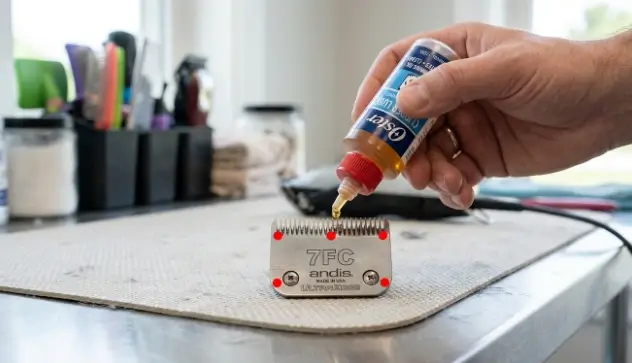
Infographic showing the professional 5-point lubrication protocol for dog clipper blades

CLINICAL MAINTENANCE PROTOCOL

Lubrication is the “lifeblood” of professional clipping. A dry blade can reach 180°F (82°C) in minutes, posing an immediate risk of clipper burn. We recommend oiling after every sanitization cycle:

Where to Oil:

  • The two back corners of the blade.
  • The center of the “cutter” teeth.
  • The “ears” of the blade guide.
  • A drop on the drive lever pivot.

What to Avoid:

  • Heavy Oils: Never use WD-40 or cooking oils; they gum up the motor.
  • Over-oiling: Wipe off excess. Oil leaking into the motor housing can damage electronics.

4. Drive Lever Replacement

As noted in the Anatomy of a Professional Clipper section, the drive lever is a consumable part. Professional groomers replace this every 4–6 months. If your clippers start sounding louder than usual or if the blades aren’t cutting cleanly even after being sharpened, the drive lever has likely lost its “throw” and needs to be swapped.

Pro Tip: Store your clippers with the blades pointing down or removed. This prevents any residual oil or cleaning fluid from seeping backward into the motor assembly, which is the #1 cause of electronic failure in professional Lithium-Ion units.

IX. Buying Guide: Crucial Questions to Ask Before Purchase

Investing in a professional-grade instrument is a significant step in your journey of systemic stewardship. Because the market for the best professional dog clippers is high-value, it is prone to superficial marketing claims. To ensure your purchase meets the clinical and mechanical standards of PetCareCompass, you must audit each potential model against these professional benchmarks.

1. Is the Motor “Brushless”?

In 2026, brushless technology is the professional floor. If a model doesn’t explicitly state “Brushless,” it likely uses older carbon-brush tech, which runs hotter and has a shorter mechanical lifespan.

2. Is it “A5 Compatible”?

Avoid proprietary blade systems. A professional clipper should allow you to use industry-standard A5 Detachable Blades from multiple brands, ensuring you aren’t locked into a single supplier.

3. What is the Serviceability?

Professional tools are meant to be repaired, not replaced. Check if the manufacturer sells replacement drive levers, batteries, and cords. If the unit is sealed and unserviceable, it is not a professional tool.

4. Does it offer Constant Speed?

Look for “Constant Speed Control” or “Torque Sensing” technology. This ensures the blade SPM (Strokes Per Minute) remains identical regardless of whether you are cutting fine hair or a thick mat.

The Warranty & Support Audit

A professional tool should come with a professional commitment. In our audits, we prioritize brands that offer at least a 2-year mechanical warranty. Additionally, consider the availability of sharpening services and authorized repair centers in your region. A clipper that has to be shipped internationally for a 5-minute drive-lever swap is a liability to your stewardship schedule.

The Cordless Battery Check:

If choosing a cordless model, verify the Battery Chemistry. Ensure it is Lithium-Ion (Li-ion) to avoid “memory effect” power degradation. Ideally, the unit should include two swappable batteries; a clipper that cannot be used while charging is a bottleneck in a professional workflow.

Final Pre-Purchase Thought: Hold the clipper if possible. Ergonomics are subjective. A clipper that is “top-rated” but feels unbalanced in your specific grip will eventually lead to fatigue and imprecise results.

X. Conclusion: Investing in Excellence

Selecting from the best professional dog clippers is more than a technical upgrade; it is an elevation of your role as a caregiver. In the framework of systemic stewardship, we recognize that the quality of the finish is directly proportional to the quality of the instrument. A professional-grade clipper provides the torque to handle challenges, the thermal management to ensure safety, and the ergonomics to protect the steward’s own physical longevity.

Whether you are a seasoned groomer in a high-volume salon or a dedicated home steward managing the coat of a complex breed, your tools should never be the bottleneck of your care. By moving toward brushless motors, A5 compatibility, and lithium-ion stability, you ensure that every grooming session is a clinical success rather than a mechanical struggle.

The PetCareCompass 2026 Verdict

For total versatility and modern durability, the Wahl KM10 remains our top recommendation for coat-type flexibility. However, for stewards requiring maximum mobility without a cord, the Heiniger Saphir stands as the unrivaled clinical gold standard.

“True stewardship is found in the intersection of compassionate handling and professional-grade precision.”

PetCareCompass Clinical Audit

This technical guide on the best professional dog clippers was architected by the PetCareCompass SEO & Editorial team. It serves as an authoritative resource for veterinary-aligned grooming stewardship. Every recommendation is based on mechanical torque audits, thermal dissipation testing, and ergonomic health standards for 2026.

© 2026 PetCareCompass – Stewardship Through Science.

Experience
Expertise
Authority
Trust

Explore This Guide

Find More Dog Care Guides

Continue exploring practical guides related to this topic.

Dog Grooming Tools Guide: Brushes, Clippers & Essential Tools Explore Guide