
Summer Gear for Dogs: Thermodynamics & Clinical Safety Guide
Navigating the summer months requires a strategic shift in how we approach canine exercise. High ambient humidity and solar radiation are not just discomforts; they are physiological stressors that challenge a dog’s ability to maintain thermal homeostasis. Without appropriate intervention, routine walks can quickly escalate into dangerous medical emergencies.
This guide deconstructs the essential Summer Gear needed to facilitate heat dissipation, protect the dermal integrity of paw pads, and maintain systemic hydration, ensuring your dog stays active and safe throughout the season.
⚖️ Safety Disclaimer: Extreme Heat Risk
Extreme heat can lead to fatal heatstroke in minutes. Summer gear is a supportive tool, not a fail-safe. Never leave a dog unattended in high-temperature environments, and always consult a veterinarian if your dog shows signs of respiratory distress or thermal trauma.
🛡️ The Foundation of Summer Heat Management:
- Conductive Cooling: Utilizing gear to draw heat away from the body surface.
- Thermal Barriers: Protecting sensitive paw pads from hyperheated substrates like asphalt.
- Hydration Kinetics: Implementing proactive water routines to prevent clinical dehydration.
Practical Implementation: Gear Selection for Daily Exercise
Maintaining a consistent exercise regimen during high-heat months necessitates a strategic approach to Summer Gear. The objective transcends mere aesthetics; it is a clinical effort to mitigate solar radiation absorption and defend against thermal injury from hyperheated surfaces. By utilizing equipment designed for physiological support, owners can facilitate effective body temperature regulation even as ambient temperatures fluctuate.
1. Biomechanics and Ergonomic Fit
For any cooling apparatus—particularly a cooling vest for dogs—to function optimally, the interface between the fabric and the canine’s torso must be precise. An improper fit does more than cause discomfort; it creates “dead air” spaces that insulate heat rather than dissipate it.
💡 Expert Verdict: The Snug-Fit Efficiency
A cooling vest relies on conductive heat transfer. If the gear shifts or hangs loosely, the evaporative layer cannot draw heat away from the skin surface. Ensure the vest maintains light, consistent contact with the chest and belly—the primary areas for vascular heat exchange.
Fit Criteria Checklist:
- Multi-point adjustment: Essential for preventing “vest rotation” during active gait.
- Scapular freedom: Gear must not restrict the shoulder’s range of motion.
- The Two-Finger Rule: Check for constriction at the trachea and axillary (armpit) regions.
2. Fabric Technology: Beyond Basic Coverage
Effective Summer Gear utilizes advanced textiles to manage the microclimate around a dog’s body. Avoiding heat-trapping materials like heavy neoprene is critical for preventing accidental overheating.
Hydro-Functional Fabrics
Materials like breathable mesh and moisture-wicking layers facilitate controlled evaporation, mimicking human sweat.
Reflective Shielding
Integrated UV protection for dogs uses light-colored outer membranes to bounce solar energy away from the coat.
3. Strategic Deployment: When Gear is Essential
Equipment should be deployed based on environmental triggers rather than a fixed schedule. Understanding the Heat Index is more valuable than just checking the temperature.
🚩 Clinical Red Flag: Humidity & Panting Efficiency
When relative humidity exceeds 70%, a dog’s panting becomes significantly less effective as moisture cannot evaporate from the tongue. In these “swampy” conditions, Summer Gear like cooling vests must be monitored closely; if the vest dries out, it may act as an insulator rather than a coolant.
Always prioritize shaded routes and perform a 5-second tactile pavement check before starting any mid-day walk.
Advanced Hydration Strategies for Thermal Resilience
During peak summer, systemic hydration is the primary determinant of a dog’s thermal resilience. As ambient temperatures climb, dogs lose significant moisture through the respiratory tract via panting—their main mechanism for heat exchange. Utilizing specialized Summer Gear designed for hydration ensures consistent fluid intake, effectively mitigating overheating risks during sustained outdoor exercise.
1. Fluid Portability & Bio-Security
In outdoor environments like public trails or urban parks, water quality is as vital as quantity. Relying on shared public bowls introduces risks of cross-contamination and bacterial exposure (e.g., Leptospirosis). A dedicated portable water bottle for dogs serves as a bio-secure hydration source.
💡 Expert Verdict: The Micro-Sipping Protocol
To optimize body temperature regulation, prioritize “Micro-Sips” (small, frequent amounts every 10–15 minutes) over large volumes at long intervals. This prevents gastric distension and ensures a steady supply of moisture for mucosal surfaces where evaporative cooling occurs.
Essential Features for Hydration Gear:
- BPA-Free / Stainless Steel Materials
- Integrated Drinking Troughs
- One-Hand Mechanical Release
- Leak-Proof Hermetic Seals
2. Physiological Monitoring & Hydration Frequency
Hydration frequency is a proactive measure, not a reactive one. By the time a dog shows clinical signs of thirst, they may already be experiencing mild thermal stress.
| Phase | Clinical Hydration Routine |
|---|---|
| Pre-Exertion | Voluntary intake 15-20 minutes before activity. |
| Active Phase | 3-5 ounces of water during every shade break. |
| Recovery | Post-walk cooling in shade before ad libitum drinking. |
🚩 Clinical Red Flag: Beyond Panting
Do not rely solely on panting as an indicator of hydration status. Monitor for Xerostomia (dry/tacky gums) or “thick” saliva. If your dog’s gums feel sticky rather than slippery, they are entering a state of clinical dehydration and require immediate shade and fluid intervention.
Solar Defense: Mitigating Radiant Heat & UV Damage
Direct UV exposure does more than raise skin surface temperature; it accelerates systemic dehydration and increases the metabolic demand for panting. Strategic Summer Gear designed for sun protection creates a vital barrier against radiant heat, allowing for safer midday outings by stabilizing the dog’s thermal microclimate.
1. Engineering Portable Shade Anchors
Relying on natural shade (like trees) is often ineffective due to the shifting solar angle. Engineering a predictable rest zone with portable Summer Gear ensures your dog has a high-ventilation sanctuary, regardless of the environment.
💡 Expert Verdict: The Convection Advantage
When selecting the best shade options for dogs, prioritize elevated cots with mesh canopies. Elevating the dog off the ground allows for 360-degree convective cooling, preventing conductive heat transfer from hot pavement or sun-soaked grass—which can be 20-30°F hotter than the air.
Tactical Shade Configurations:
- Pop-Up Tents: Best for high-wind environments (beaches/parks). Ensure dual-entry points for cross-ventilation.
- Tailgate Panels: Essential for road trips to block solar gain through vehicle glass during rest stops.
2. UV-Shielding Fabrics & Dermal Protection
For active movement where stationary shade isn’t possible, lightweight UV protection for dogs is a clinical necessity—especially for breeds with thin coats or unpigmented skin susceptible to solar dermatitis.
🚩 Clinical Red Flag: Solar Thermal Burn
Sunburn in dogs often presents as persistent redness, scaling, or skin thickening on the bridge of the nose or ear tips. If left unprotected, chronic UV exposure can escalate into squamous cell carcinoma. Always utilize UPF-rated fabrics and avoid heavy insulators that contribute to overheating risks.
Material Checklist for Sun-Protection Gear:
- Light Color Spectrum: Reflects rather than absorbs solar energy.
- UPF 50+ Rating: Blocks 98% of harmful UVA/UVB rays.
- Aero-Mesh Panels: Facilitates airflow during high-exertion segments.
- Non-Restrictive Cut: Prevents chafing at axillary friction points.
Paw & Surface Protection: Safeguarding the Dermal Barrier
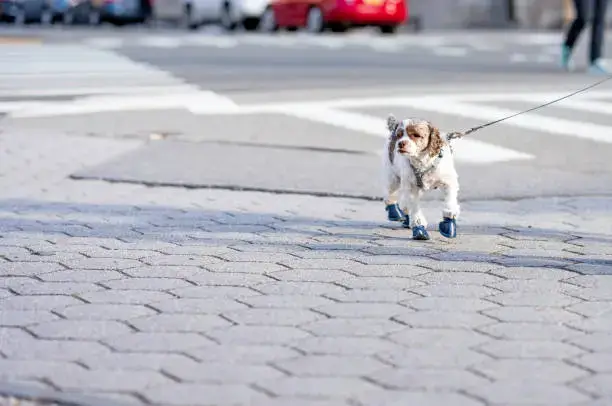
Canine paw pads are highly specialized structures, but they lack significant thermal insulation. On a 90°F day, asphalt temperatures can skyrocket to over 140°F—hot enough to cause permanent scarring in under 60 seconds. Utilizing targeted Summer Gear for paw protection is a clinical necessity for maintaining dermal integrity and ensuring mobility on hyperheated urban and trail surfaces.
1. Advanced Barriers: Dog Summer Boots & Waxes
The primary function of surface-oriented gear is to disrupt thermal conductivity. Whether using dog summer boots or breathable waxes, the goal is to provide a reliable buffer against paw pad sensitivity without compromising the dog’s natural gait.
💡 Expert Verdict: The Ventilation-Traction Balance
When selecting dog summer boots, prioritize perforated mesh uppers. Unlike winter boots, summer footwear must allow heat to escape from the top of the paw. Ensure the soles are made of thin, heat-resistant rubber to maintain proprioception, which prevents tripping and anxiety.
Technical Criteria for Summer Footwear:
- Slip-Resistant Vibram/Rubber Soles
- Double-Wrap Secure Straps
- 360° Reflective Trim
- Low-Profile Ergonomic Cut
2. Thermal Thresholds and Pavement Audits
Before deploying gear, performing a “Surface Audit” is essential. Hot pavement protection for dogs begins with situational awareness: if a surface is too hot for your palm, it is a biological hazard for your dog.
🚩 Clinical Red Flag: Beyond Asphalt
Artificial turf and beach sand often harbor higher radiant heat than asphalt. Turf, in particular, can reach 160°F+ due to its synthetic composition. If you notice your dog lifting paws repeatedly, licking their pads, or seeking shade aggressively, they are likely experiencing thermal trauma and need immediate surface transition.
Urban & Cityscapes
Metal grates and dark pavement require full-boot coverage. Focus on high-durability soles to resist abrasive city surfaces.
Boats & Marine Environments
Focus on hydro-traction. Boots prevent slipping on wet fiberglass and shield paws from intense reflection off the water surface.
Safe Exertion: Managing Exercise Metabolism in High Heat
Maintaining physical activity during the summer requires a delicate balance between mental enrichment and thermal safety. High humidity and direct solar gain increase the metabolic heat load on a dog, making airflow ventilation and targeted Summer Gear essential components of any outdoor routine.
1. Engineering Safe Outdoor Activity
To support sustained movement, gear must facilitate heat dissipation. A dog hydration pack or a cooling bandana works by utilizing the principles of evaporation and conduction to draw heat away from major vascular centers like the neck and chest.
💡 Expert Verdict: The Hydro-Thermal Cool-Down
Water-based activities are the most effective way to lower core body temperature due to water’s high thermal conductivity. However, always transition from water play to shade immediately. Evaporative cooling only works if there is sufficient airflow ventilation to move moisture away from the coat.
2. Strategic Timing & Environmental Audits
Exercise should be scheduled based on diurnal temperature variation—prioritizing windows when ambient temperatures are at their lowest.
Optimal Windows
Pre-9 AM and Post-6 PM. These periods minimize UV exposure and cumulative ground heat.
Substrate Selection
Prioritize grass medians and shaded trails to avoid thermal conductivity from asphalt.
🚩 Clinical Red Flag: Early Overheating Signifiers
Watch for hypersalivation (thick, ropey drool) and “spatulate” tongue—where the tongue flattens and widens significantly to increase surface area for panting. If your dog exhibits these signs, cease activity and apply cool (not ice-cold) water to the groin and axillary areas.
3. Post-Walk Recovery Protocols
Recovery Action Steps:
- Dermal Cooling: Wipe paws with cool towels to assist in rapid heat release.
- Passive Cooling: Utilize a cooling mat to encourage conductive heat loss during rest.
- Voluntary Hydration: Offer fresh water immediately but monitor for over-consumption.
Clinical FAQ: Expert Insights on Summer Safety
Q1: Is specialized Summer Gear clinically necessary for all dogs?
While individual tolerance varies, most dogs benefit from environmental interventions. Items like heat-resistant booties and evaporative cooling vests are essential for mitigating thermal stress in urban environments.
Q2: How can I identify the early stages of Hyperthermia?
Monitor for excessive panting, persistent seeking of shade, and “brick red” mucous membranes. If your dog exhibits ataxia (stumbling) or thick saliva, immediate intervention is required.
Q3: Does a short coat provide better cooling efficiency?
Not necessarily. Short-coated breeds lack the insulating “loft” of a double coat, making them more susceptible to direct solar gain and UV damage. Reflective Summer Gear is highly recommended.
Q4: Are cooling mats effective for post-exertion recovery?
Yes. Cooling mats facilitate conductive heat loss by drawing core heat into the gel or water-filled medium, offering a low-stress tool to lower heart rate and respiratory effort.
Conclusion: Empowering Summer Adventures
Summer doesn’t have to mean a sedentary lifestyle for your canine companion. By integrating clinical awareness with the right Summer Gear, you can transform hazardous conditions into manageable outdoor routines. At PetCareCompass, our mission is to provide you with the evidence-based tools and practical habits needed to ensure your dog thrives in every season.
Find More Dog Care Guides
Continue exploring practical guides related to this topic.