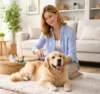
Training Note: This guide utilizes Positive Reinforcement and science-based behavioral shaping. Always monitor your dog for signs of “Mental Fatigue” or frustration; training should be paused if the dog exhibits persistent disengagement or stress signals.
For a dog, learning new tricks is a high-level cognitive workout that stimulates Neuroplasticity and staves off age-related decline. While most owners focus on the final “trick,” the clinical value lies in the Operant Conditioning process itself. By utilizing structured Shaping techniques and a reward-based framework, you transform a simple command into a powerful tool for mental agility and psychological resilience.
Cognitive Objectives:
- Boosting Dopaminergic Reward responses.
- Enhancing Proprioception (body awareness).
- Strengthening the Human-Canine Attachment bond.
This guide provides a professional roadmap to make learning new tricks a practical, stress-free, and deeply rewarding experience for both you and your companion.
Deciphering Cognitive Preferences: The Key to Faster Acquisition
In learning new tricks, efficiency is dictated by how well the training format aligns with your dog’s Sensory Processing. Dogs are not “blank slates”; they possess innate cognitive biases—some are highly attuned to Visual Discrimination (hand signals), while others excel in Auditory Nuance (verbal inflection). Identifying these “Learning Channels” allows you to reduce communication friction and accelerate the Neural Mapping of new behaviors.
Visual vs. Auditory: Mapping the Sensory Channels
Studies in canine cognition suggest that dogs often prioritize body language over verbal cues. However, individual variations are significant. Monitoring your dog’s Gaze Orientation during the initial “Luring” phase of learning new tricks will reveal their primary channel.
- Visual Dominance: These dogs respond faster to Hand Signals and subtle shifts in your shoulder alignment. They are ideal candidates for “Capturing” techniques where you reward a natural movement.
- Auditory Sensitivity: These dogs react to changes in pitch and Verbal Markers. They often require extremely consistent tone to prevent “Signal Decay” during complex trick sequences.
The Motivation Matrix: Caloric vs. Social Reinforcement
Effective learning new tricks relies on the Dopaminergic System. While high-value treats (Caloric Reinforcement) are the most common driver, many “High-Drive” breeds (like Shepherds or Collies) may prioritize Prey-Drive Play (Tug or Fetch) as a more potent reward.
| Driver Type | Best For… | Maya’s Pro Strategy |
|---|---|---|
| High-Value Treats | Precision behaviors (Sit, Stay). | Use “Smelly” proteins to bypass environmental distractions. |
| Play/Tug Rewards | High-energy tricks (Spin, Jump). | Limits boredom; builds explosive Engagement. |
| Social Praise | Maintenance & Generalization. | Pair with physical touch to lower Cortisol in anxious learners. |
Neural Fatigue and the 5-Minute Rule
Canine Attention Spans are biologically limited. During learning new tricks, the brain consumes a massive amount of glucose. Once Neural Fatigue sets in, the dog will exhibit Displacement Behaviors (yawning, sniffing the ground, or scratching). To maximize Memory Consolidation, keep sessions brief and conclude while the dog is still in a state of high arousal.
Architecting Focus: The Stress-Free Training Environment
In learning new tricks, the environment acts as the “operating system” for your dog’s brain. If the background noise or visual clutter is too high, the Amagdyala (the brain’s emotional center) may override the Prefrontal Cortex (the analytical center), leading to frustration. By engineering a low-arousal workspace, you ensure that every neural resource is dedicated to Information Processing.
The Indoor “Lab” vs. The Outdoor “Field”
The location should align with the stage of Neural Consolidation. For Acquisition (the first time a dog tries a trick), an indoor “Lab” environment with neutral lighting and zero olfactory distractions is mandatory. Only once a trick reaches Fluency should you transition to the outdoor “Field” to test for Generalization.
- Visual Silence: Remove high-arousal items like squeaky toys or the presence of other pets which can trigger Prey Drive or social anxiety.
- Olfactory Neutrality: Avoid training near the kitchen or areas with strong food smells that might lead to “Frustrated Motivation.”
Timing and Biological Alertness
Successful learning new tricks is synchronized with your dog’s Circadian Rhythm. Post-meal lethargy (the “food coma”) is the worst time for cognitive work. Aim for periods of Optimal Arousal—usually mid-morning or early evening—when the dog is physically satisfied but mentally eager for engagement.
Precision Tools: The Clicker as an Event Marker
In learning new tricks, clarity is everything. A Clicker or a consistent verbal marker (like a short “Yes!”) serves as a bridge between the correct movement and the reward. This creates a Binary Communication system: the sound marks the exact millisecond the Dopamine should spike, making the learning curve much steeper.
| Tool / Setup | Cognitive Function | Maya’s Pro Tip |
|---|---|---|
| Clicker | Instant behavioral marking. | “Load” the clicker first by clicking and treating 10 times to build the association. |
| Target Stick | Visual guidance (Luring). | Great for “complex” tricks like Leg Weaves without bending over. |
| Interactive Mats | Mental stamina building. | Use a Snuffle Mat after a session to help the dog decompress. |
From Mechanics to Mastery: Step-by-Step Behavioral Shaping
In learning new tricks, we utilize Successive Approximation—breaking a complex movement into digestible, biological steps. By using Luring (guiding with food) and Capturing (marking a natural movement), you communicate directly with the dog’s Motor Cortex. This ensures that the behavior is physically comfortable and mentally “stuck” for long-term retention.
The Foundation: Sit and Stay (Impulse Control)
The “Sit” is the gateway to learning new tricks. It centers the dog’s gravity and shifts them into a “Listening State.”
- The Lure: Move the treat in an arc over the nose toward the tail. This forces the Hindquarters to drop naturally. Mark (click) the millisecond the pelvis touches the floor.
- Duration Building: For “Stay,” introduce a Variable Reinforcement Schedule. Reward at 2 seconds, then 5, then 3. This teaches the dog that staying is a dynamic job, not a static one.
Shake & Paw: Proprioceptive Awareness
Teaching a dog to use their paws enhances Proprioception (body awareness).
Hold a treat in a closed fist. Most dogs will instinctively “paw” at your hand to open it. The moment the paw lifts even 1 inch off the ground, Mark and Reward. You are capturing the natural problem-solving instinct and labeling it with a command.
Spin & Roll Over: Vestibular Engagement
Complex tricks like “Spin” or “Roll Over” engage the Vestibular System (balance).
| Trick Type | Primary Technique | Cognitive Difficulty |
|---|---|---|
| Spin / Twirl | Continuous Nose Lure. | Low (Natural movement). |
| Roll Over | Multi-stage Shaping. | Moderate (Requires vulnerability). |
| Back Up | Pressure Spatial Luring. | High (Unnatural reverse motion). |
For more advanced ways to challenge your dog’s mind, explore our master guide on Mental Stimulation for Dogs at Home.
Advanced Cognitive Loading: Pushing the Limits of Learning
In the final stages of learning new tricks, we transition from motor-skills to Executive Functioning. Advanced tasks like Object Discrimination and scent-based navigation require the dog to hold information in their Working Memory while filtering out irrelevant stimuli. This high-level mental loading is the most effective way to maintain Synaptic Plasticity as your dog matures.
Object Discrimination: Building a Vocabulary
Learning new tricks involving item names (e.g., “Find Ball” vs. “Find Bear”) engages the dog’s Language Processing centers. Dogs are capable of fast-mapping labels to specific objects, a cognitive trait similar to human toddlers.
- Isolation Phase: Start with one known object and one “neutral” object (like a plain block). Reward the dog ONLY for touching the known object.
- Olfactory Reinforcement: Leverage their Primary Sense. Lightly scenting a specific toy can help bridge the gap during the initial association phase.
- Generalization: Once they succeed with two items, introduce a third. This forces the brain to use Exclusionary Reasoning (“It’s not A or B, so it must be C”).
Hide and Seek: Spatial Memory & Tracking
Hide and seek is a sophisticated exercise in Spatial Awareness and olfactory tracking. It forces the dog to utilize their Hippocampus to remember your last known location while processing scent trails.
| Advanced Game | Cognitive Skill Targeted | Maya’s Pro Strategy |
|---|---|---|
| Scent Discrimination | Olfactory Processing. | Use Birch or Lavender oil to mark the target item. |
| Reverse Hide & Seek | Scent trailing & recall. | Hide a high-value item and use the command “Search.” |
| Multi-Step “Chaining” | Sequential Memory. | Chain “Go to Bed” followed by “Stay” and “Lay Down.” |
The Chemistry of Success: Mastering Positive Reinforcement
In learning new tricks, positive reinforcement is more than just “giving treats”; it is the management of Contingency—the immediate relationship between a behavior and its consequence. When a reward follows a behavior within the 1-second Temporal Window, it triggers a Dopamine spike that effectively “hardwires” that neural pathway, making the behavior far more likely to be repeated in the future.
The Evolution of Reward Schedules
To achieve Fluency in learning new tricks, your reward strategy must evolve.
- Continuous Reinforcement (Acquisition): Reward every single correct attempt. This is essential for the Initial Learning Phase to build clarity.
- Intermittent Reinforcement (Maintenance): Once the trick is mastered, reward only the best attempts. This “gambling effect” makes the behavior more resistant to Extinction (forgetting).
Verbal Precision vs. Physical Affection
Dogs are masters of Auditory Inflection. A high-pitched, enthusiastic “Yes!” serves as a Secondary Reinforcer, bridging the gap between the action and the treat. While physical petting is valuable, it can sometimes be distracting during Precision Training. Use petting as a “Jackpot” at the very end of a session to lower Cortisol and promote bonding.
Tracking Cognitive Growth: The Training Audit
Managing the Cognitive Load during learning new tricks requires consistent monitoring. A training journal is your diagnostic tool, allowing you to see patterns in Neural Consolidation and identify when a dog is ready for Criteria Elevation (increasing difficulty).
| Audit Metric | What to Record | Clinical Adjustment |
|---|---|---|
| Latency | Time between command and action. | If latency is >3s, simplify the visual cue. |
| Arousal Level | Engagement vs. Distraction. | Switch to “Higher Value” treats or move indoors. |
| Success Rate | Correct attempts out of 10. | If >80%, increase Duration or Distance. |
For more on advanced cognitive development, see the expert advice from the American Kennel Club (AKC).
Cognitive Hurdles: Navigating Resistance and Distraction
Even with a perfect protocol, learning new tricks can hit a plateau. These “blocks” are rarely a lack of intelligence; they are typically a breakdown in Threshold Management or a Negative Contrast issue (where the reward doesn’t match the effort). Identifying whether your dog is experiencing Cognitive Overload or environmental interference is the first step in restoring the training flow.
Managing Environmental Interference
If your dog fails to respond in a new environment, they aren’t being “stubborn”—they are suffering from a lack of Generalization. Dogs are context-specific learners. A trick learned in the kitchen may not exist in their brain at a busy park.
- The 3-D Rule: When distractions increase, decrease Duration and Distance. Simplify the new trick until the dog regains a 80% success rate.
- Value Inflation: If the environment is “loud” (noisy, smelly), your reward must be “louder.” Switch from dry kibble to high-moisture proteins like liver or salmon.
Addressing Anxiety and Frustration
High-stress levels inhibit Latent Learning. When a dog enters a state of Amygdala Hijack (fear or extreme frustration), the learning centers of the brain shut down. This often manifests as “shutting down”—the dog stops moving or avoids eye contact.
| Behavioral Signal | Psychological Cause | Maya’s Intervention |
|---|---|---|
| Excessive Sniffing | Displacement behavior (Stress). | End session. Allow 2 minutes of free sniffing to lower Cortisol. |
| “Zoomies” (FRAPs) | Overstimulation/Adrenaline. | Pause training. Use a calm “down-stay” to regulate arousal. |
| Vocalizing / Barking | Communication Frustration. | Simplify the task. You are asking for too much, too soon. |
Expert FAQ: Fine-Tuning the Learning Experience
❓ How long does it take for a dog to master a new trick?
Mastery is divided into Acquisition (3-5 days) and Fluency (2-3 weeks). While a dog might perform a trick in your kitchen quickly, true mastery requires Generalization—performing the trick in at least 3 different environments with 80% accuracy.
❓ What if my dog suddenly loses interest or “forgets”?
This is often Neural Fatigue or “Latent Learning” plateaus. If interest drops, switch to a High-Value Reinforcer or end the session immediately. Over-training can lead to Learned Helplessness or a negative association with the training area.
❓ Can senior dogs continue learning new tricks?
Yes. In fact, Cognitive Enrichment is vital for seniors to stave off Canine Cognitive Dysfunction (CCD). Focus on low-impact, stationary tricks that prioritize Object Discrimination over high-energy physical movements.
❓ Why is my dog barking during training sessions?
Barking is a sign of Frustration Arousal. It usually means your Criteria are too high or your Rate of Reinforcement is too low. Simplify the task (Split the behavior) and reward more frequently to restore calm focus.
❓ Should I use a clicker for every new trick?
While not mandatory, an Event Marker like a clicker provides High-Fidelity Feedback. It removes human “noise” (tone variations) and tells the dog’s brain exactly which movement earned the reward, accelerating Synaptic Plasticity.
❓ How do I stop my dog from “guessing” tricks?
Guessing (cycling through behaviors) happens when a dog isn’t sure of the Discriminative Stimulus (the cue). Stop rewarding the guesses. Wait for a neutral “off” state, then give a clear, singular cue once. Reward only the specific response requested.
The Mastery Protocol: Daily Learning Checklist
- ✅ 3-5 reps of a known trick.
- ✅ High-engagement focus work.
- ✅ Low-arousal start.
- ✅ 10-minute New Trick focus.
- ✅ Use high-value “Jackpot” treats.
- ✅ Event Marker (Clicker) precision.
- ✅ Review mastered skills.
- ✅ Interactive Cognitive Toy session.
- ✅ End on a “Big Win.”
Conclusion: The Lifelong Impact of Mental Agility
Learning new tricks is far more than a parlor game; it is an investment in your dog’s neurological longevity and emotional resilience. By understanding Biological Learning Cycles and maintaining a stress-free environment, you bridge the communication gap between species. Whether you are mastering a simple “Sit” or a complex Scent Discrimination task, every session builds Confidence and Cognitive Depth.
Remember: Training is a conversation, not a command. Listen to your dog’s subtle cues, respect their Mental Thresholds, and enjoy the profound bond that comes from solving life’s puzzles together.
Find More Dog Care Guides
Continue exploring practical guides related to this topic.