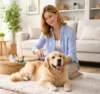
Teaching your dog to navigate solitude is more than a convenience—it is a vital component of their psychological health. Dog home alone training is the process of shifting a dog’s perspective from seeing your departure as a “loss of safety” to seeing it as a predictable, stress-free period of rest. By fostering Emotional Self-Regulation, you prevent the escalation of mild distress into chronic Separation Anxiety.
“The goal of solitude training isn’t just to stop the barking; it’s to lower the dog’s Cortisol Baseline so they can actually sleep while you’re gone. A truly trained dog doesn’t just ‘endure’ being alone—they are Neutral to it.” — Maya Mai, Senior Editor
Decoding the Language of Solitude: Signs of Emotional Escalation
In dog home alone training, success depends on your ability to read “pre-panic” signals. Dogs rarely move from calm to destructive instantly; they navigate a Stress Continuum. Identifying these subtle Biomarkers allows you to intervene before your dog crosses their Panic Threshold.
1. Recognizing Micro-Signs of Stress
Beyond obvious barking, pay close attention to physiological indicators suggesting flight mode:
- Stereotypic Pacing: Walking repetitive paths near exits.
- Hypervigilance: Intense focus on windows/doors reacting to hallway micro-sounds.
- Hypersalivation: Excessive drooling as a classic severe anxiety sign.
- Oral Fixation: Excessive paw/flank licking as a soothing coping mechanism.
⚠️ The “Silent Sufferer” Warning
Do not assume silence equals success. Some dogs suffer from Internalized Anxiety, remaining motionless with high heart rates and dilated pupils. Using a pet camera to audit these Static Stress Signals is a mandatory part of professional training.
2. Age-Specific Biological Constraints
Effective dog home alone training must account for the Developmental Capacities of the canine brain and body.
| Life Stage | Primary Constraint | Training Focus |
|---|---|---|
| Puppies | Bladder capacity & Social Buffering needs. | Micro-absences to prevent Isolation Distress. |
| Adults | Past traumatic associations or lack of routine. | Desensitization to Departure Cues (keys, shoes). |
| Seniors | Cognitive Dysfunction (CCD) or sensory loss. | Environmental stability and medical comfort. |
3. Environmental Triggers & Sanctuary Setup
Dogs are masters of Predictive Coding. They react to noises signaling your absence. Shielding their “Safe Zone” from external triggers allows the environment to act as a Passive Soothing System for rest and digestion.
Strategic Spatial Selection
- Den-like Enclosure: Utilize corners or alcoves to reduce 360-degree monitoring.
- Acoustic Masking: Use white noise or canine bio-acoustic music.
- Thermal Comfort: Ensure stable ventilation for self-regulation.
🧪 Maya Mai’s Pro Tip: The “Scent-Soak” Method
Place a t-shirt worn for 8+ hours inside your dog’s bed. This provides a constant stream of your Pheromones, clinically shown to reduce heart rate. Avoid freshly washed items with chemical detergent scents.
Preventive Safety & Binary Communication
Preventive Safety Audit
- Hazard Elimination: Secure electrical cords and remove low-hanging curtains.
- Exit Point Reinforcement: Use plastic door guards against scratching.
- Toxic Audit: Lock high-shelf items (essential oils, medications, chocolate).
Safety Cue Strategy
Use specific signals during practice absences to guarantee return:
- Visual Cue: Place a colored mat or ribbon on the door handle only during practice.
- Olfactory Cue: Use a specific calming scent (diluted Lavender) during alone time.
Stress at home is rarely a single-issue problem. Cross-reference our guides on Dog Behavior at Home, managing Excessive Barking, and decoding Subtle Stress Signs.
Systematic Desensitization: Building Duration Safely
The core of professional dog home alone training is Systematic Desensitization. Expose your dog to absence below their Panic Threshold to avoid triggering the fight-or-flight response in the amygdala.
| Phase | Action Protocol | Goal |
|---|---|---|
| Tier 1 | In-Home Distance: Being in another room with a baby gate or closed door. | 2–5m |
| Tier 2 | Micro-Exit: Stepping outside the front door and returning immediately. | 30s – 2m |
| Tier 3 | Functional Absence: Brief errands like checking mail or taking out trash. | 10–20m |
High-Value Occupancy
- 🧊 Hydro-frozen Kongs: Freezing treat-stuffed toys increases engagement time.
- 👃 Olfactory Puzzles: Snuffle mats utilize secondary olfactory systems for faster sleep.
Maya Mai’s Insight: The “Cool-Down” Rule
When returning home, ignore your dog for the first 3-5 minutes until they show relaxed body language. This prevents Anticipatory Spiking where dogs get anxious predicting a high-energy return.
Case Study: The Balanced Morning
- ✔ T-60: Physical exercise (drainage).
- ✔ T-30: Mental training (cognitive fatigue).
- ✔ Departure: Deploy a frozen puzzle; silent exit.
Gradual Extension: Mastering Linear Duration Scaling
Once your dog achieves Emotional Baseline during micro-absences, scale duration to build Cognitive Endurance for extended rest cycles.
| Timeline | Target Window | Success Metric |
|---|---|---|
| Days 1–3 | 10–15 Minutes | Self-soothing with toys |
| Days 4–7 | 20–45 Minutes | Deep breathing; lying down |
| Week 2+ | 90+ Minutes | Full sleep cycles reached |
Panting, frantic pawing at exits, or refusal of high-value treats while alone.
Slow eyelid blinks, stretching, and disinterest in departure cues.
Maya Mai’s Strategy: The Regression Protocol
Training isn’t always linear. If your dog panics at 30 minutes after succeeding at 20, do not push forward. Immediately lùi lại (regress) về mốc 10 phút trong 2 ngày để “phục hồi” sự tự tin. Đây là cách ngăn chặn Negative Reinforcement—nơi chó học được rằng lo lắng sẽ kéo dài mãi mãi.
The Denning Sanctuary: Leveraging Crate Training for Peace
Crate training provides a Biological Den. When integrated correctly, the crate becomes a “Zero-Stress Zone” where the dog feels physiologically incapable of panic.
Leave door open. Let dog enter voluntarily to find hidden treats.
Close door for 2–5 minutes with long-lasting chew while in sight.
Gradually move out of sight. Crate should mean only good things happen.
Maya Mai’s Critical Warning: The Safety Audit
Before leaving a dog alone in a crate, perform a Hazmat Audit. Remove collars (choking risk) and ensure no bedding has loose threads. Per the ASPCA, stress chewing can lead to ingestion of toxic plants or plastic. Use heavy-duty rubber toys for power chewers.
Troubleshooting: Navigating Behavioral Roadblocks
If a dog barks immediately upon departure, they are in Acute Panic. If they bark after 2 hours, they experience Isolation Frustration.
Never return while actively barking to avoid Accidental Reinforcement (“Noise = Return”). Wait for 5-10 seconds of silence before entering.
Afternoon Training Scenario
- 13:00 Bio-Break & Play: Complete elimination and high-arousal play.
- 13:15 Enrichment: Place in sanctuary with frozen puzzle toy.
- 14:30 Calm Reunion: Return quietly. Reward when four-on-floor and silent.
Advanced Resilience: Cultivating a Confident Dog
Transition from “tolerating” solitude to “embracing” it through neuro-psychological conditioning for restorative sleep.
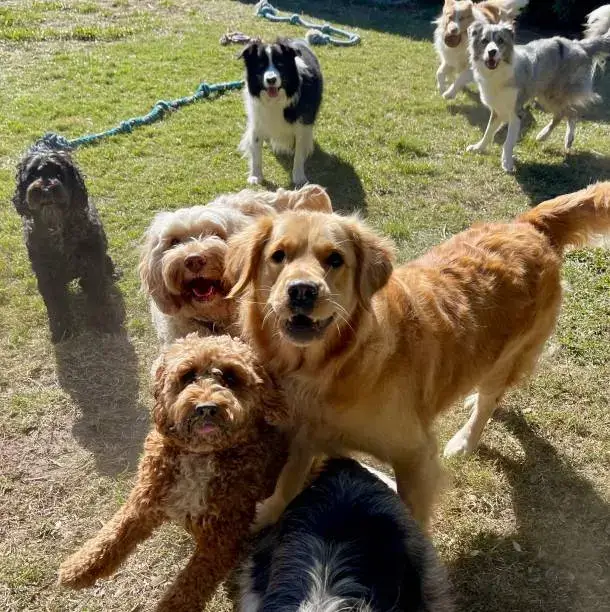
1. Breaking the “Velcro Dog” Cycle
- Stay-Put Command: Reward staying on bed while you move to another room.
- Zero-Attention Rest: Avoid hovering or constant eye contact.
2. Cognitive Labor vs Physical Exercise
- Scent Scavenger Hunt: Hide small treats in safe zone 5 mins before leaving.
- Precision Trick Training: 5-minute brain workout exhausts CNS fast.
- Environmental Variety: Rotate interactive puzzles daily.
Maya Mai’s Pro Metric: The AKC Standard
Per the American Kennel Club (AKC), adjusting environmental variables like ambient noise and thermoregulation is critical. Anxious dogs experience body temperature increases. Setting thermostats 1-2 degrees cooler prevents physical discomfort that triggers panic spirals.
Auditory Buffering & Solitude Success Checklist

Pre-Departure & Post-Return Operational Audit
Expert FAQ: Navigating the Nuances of Solitude
How long can an adult dog stay alone?
While many tolerate 4–6 hours, it depends on biological threshold. Training ensures they rest rather than experience high cortisol levels.
Is the crate ever a negative space?
Only if used as punishment. If frantic escape attempts occur, pause training and consult a behaviorist for confinement distress.
Why chew forbidden items only when gone?
This is displacement behavior to self-soothe heart rate. Redirect energy with high-value puzzle chews during absences.
Clinical Intervention & Conclusion
🩺 Medical Support & Behavior Modification
In severe cases, veterinarians prescribe anxiolytics to lower arousal baselines so learning can occur. Never use medications without a professional diagnosis.
Mastering dog home alone training is a journey of building mutual trust. By shifting from a reactive approach to Systematic Desensitization, bạn đang bảo vệ sự bình yên trong tâm trí của thú cưng. Remember, a dog comfortable alone is truly free to rest.
Ready for the Next Level?
Home alone training is just one part of your dog’s behavioral health. Explore our other guides to build a truly harmonious home.
Find More Dog Care Guides
Continue exploring practical guides related to this topic.